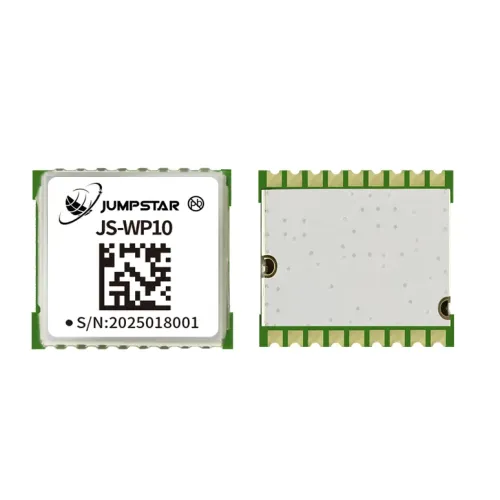
Features
Why Choose Jumpstar?

We Have The Best Solutions for Your Business
Empowering Global Industries with High-Precision GNSS
Founded 16 years ago, Shenzhen Jumpstar Technology is a leading innovator in GNSS positioning. As a direct source manufacturer, we specialize in the R&D and production of advanced GNSS modules, RTK boards, antennas, and tracking terminals.
Empowering industries like UAVs, precision agriculture, and land surveying, we are committed to delivering reliable centimeter-level accuracy and flexible OEM/ODM solutions to integrators worldwide. Partner with Jumpstar to drive your next technological breakthrough.
GNSS Module: A Complete Guide to Types, Specifications and Selection
A GNSS module is the component that turns satellite signals into the position, velocity and timing data a modern product depends on. Whether the end device is a surveying rover, an agricultural drone, a shared scooter or a smart meter, the module sits at the heart of the positioning chain, and its performance defines the ceiling of what the whole system can achieve. Choosing the right one is therefore not a component decision — it is a product decision. This guide explains what a GNSS module is, which specifications actually matter, how the main module categories differ, and where the JUMPSTAR GNSS module family fits into each use case. Along the way it compares three representative modules and closes with a practical selection checklist for engineering teams.
What Is a GNSS Module and What Does It Do?
A GNSS module is a compact receiver subsystem that integrates an RF front end, a baseband processor, correction interfaces and firmware into a single solderable unit. Signals arrive from satellite constellations — GPS, GLONASS, Galileo, BeiDou and often QZSS and NavIC — and the module correlates them, decodes navigation messages, and outputs a positioning solution over UART, SPI, I2C or USB. To the host product, the module behaves like a data source: it streams NMEA sentences, binary protocols such as RTCM, or vendor-specific messages, and it accepts commands for configuration and correction input.
The engineering value of that integration is easy to underestimate. A discrete receiver design demands antenna matching, low-noise amplification, power sequencing, constellation firmware and RTK logic — months of specialized RF and DSP work. A qualified module compresses all of it into a verified component with a published footprint, letting a team focus on its application instead of satellite navigation. That is why modules, not chipsets, dominate commercial products from wearables to autonomous machinery. For a broader discussion of module-level integration, see the companion article GNSS module integration practices.
GNSS Module Categories: Standard, High-Precision and Dead Reckoning
The module market divides into three practical tiers. Standard-precision modules deliver meter-level accuracy from single-frequency L1 reception. They are inexpensive, power-frugal and sufficient for asset trackers, consumer devices and fleet telematics where "which street" matters more than "which lane". High-precision RTK modules add multi-frequency reception, carrier-phase measurement and RTCM correction input to reach centimeter-level accuracy. They power surveying, UAV mapping, machine control and autonomous navigation. Dead-reckoning modules couple the receiver with inertial sensors to bridge signal gaps in tunnels, urban canyons and parking structures.
A useful mental model is that these tiers differ less in "accuracy" than in their tolerance for adversity. A standard module performs well under open sky; a high-precision module keeps its accuracy while moving fast, near reflecting surfaces, or with intermittent corrections. Deciding which environment your product actually operates in is the first — and most consequential — selection step. The distinction between a receiver module and a complete receiver is clarified in GNSS module versus GNSS receiver module.
Six Specifications That Define a GNSS Module
Datasheets list dozens of parameters, but six of them determine whether a module will succeed in a given product.
- Frequency and constellation support. Single-frequency L1 reception is the baseline; dual-band L1+L5 reception removes the majority of ionospheric error and accelerates RTK convergence. Support for all four major constellations ensures redundancy when a particular system degrades.
- Horizontal accuracy. Standard modules quote 1.5–3 m; RTK modules quote roughly 1 cm plus 1 ppm of baseline length once fix is achieved. Match the number to the application, not to marketing aspirations.
- Tracking sensitivity and channels. A figure near −165 dBm tracking sensitivity with 200+ channels indicates the module can hold satellites under foliage and in urban canyons, where weaker receivers lose fix.
- Time to first fix. Cold-start values of 25–30 seconds and hot-start values of 1–2 seconds matter for battery-powered devices that wake, fix and sleep.
- Power consumption. Current draw spans from tens of milliamperes for standard modules to roughly 60 mA for RTK modules under correction load. In a battery budget, this often outweighs every other electrical parameter.
- Interfaces and correction input. UART, SPI, I2C, USB and CAN options, plus a dedicated RTCM3 correction port, determine integration effort. A dedicated correction port frees the host from routing base-station data.
Three JUMPSTAR GNSS Module Options Compared
JUMPSTAR designs its module line around the three tiers described above, and the high-precision RTK module family is where its engineering depth is most visible. Three modules illustrate the range.
JS-RK43-3: UAV-Grade RTK with Integrated Antenna
The JS-RK43-3 packages a dual-band L1+L5 receiver, 200 acquisition and tracking channels, and a tuned antenna in a single housing built for unmanned aircraft. RTK accuracy is specified at 1.0 cm + 1 ppm, and average current draw is about 58 mA at 5.0 V — low enough for multi-hour UAV missions. Because the antenna and receiver are co-designed and co-calibrated, the module eliminates the antenna-matching work that usually consumes integration schedules.
The module supports both rover and base modes, so one part can serve as a moving rover on a drone or as a local base station for a survey crew. Its behavior in production UAV fleets is documented in the case study centimeter-level precision with JS-RK43-3.
JS-ARK28-3: The Compact GNSS Module for Space-Constrained Devices
The JS-ARK28-3 measures 28 × 28 × 8 mm, weighs under 12 g, and still delivers −165 dBm tracking sensitivity with an integrated TCXO, LNA, SAW filter and RTC. It targets devices where a full high-precision receiver simply does not fit — smart meters, shared-mobility trackers, structural monitoring nodes — while preserving the satellite-tracking robustness of larger modules.
For product teams, the practical benefit is design freedom: the module's small footprint and built-in support circuitry reduce the positioning section of a PCB to a single placement, shortening layout cycles and simplifying certification.
JS-ARK37-3: Multi-Interface Module for Industrial Systems
The JS-ARK37-3 serves industrial equipment that still speaks RS232 and CAN alongside TTL serial. At 36 × 36 × 9.7 mm and under 21 g, with an optional magnetometer for heading support, it slots into machine-control terminals, agricultural implements and survey accessories whose controllers expose legacy buses rather than modern UART lines.
Interface flexibility sounds mundane until an integration stalls because a module cannot talk to a thirty-year-old PLC. The JS-ARK37-3 exists precisely to remove that class of blocker.
| Model | Bands / Channels | RTK Accuracy | Size / Weight | Best Fit |
|---|---|---|---|---|
| JS-RK43-3 | L1+L5 dual-band, 200 ch | 1.0 cm + 1 ppm | Integrated antenna, ~58 mA | UAVs, rovers and base stations |
| JS-ARK28-3 | −165 dBm tracking | Standard precision | 28 × 28 × 8 mm, <12 g | Compact IoT and tracking devices |
| JS-ARK37-3 | TTL / RS232 / CAN | Standard precision | 36 × 36 × 9.7 mm, <21 g | Industrial and machine control |
Where Different Products Use Each GNSS Module Type
In UAV mapping, the module carries photogrammetry constraints: centimeter-level ground accuracy, fast convergence between flight lines, and vibration tolerance. The JS-RK43-3 addresses these directly, and its integrated antenna keeps airframe integration simple. In surveying and GIS, modules pair with corrections from network RTK services, so correction-format compatibility and a stable fix indicator become selection criteria.
In fleet telematics and shared mobility, the priorities invert: cost, power and size dominate, and lane-level accuracy is a bonus rather than a requirement — the natural territory of compact modules like the JS-ARK28-3. In agriculture and construction, machines work under canopies and near reflective structures, so multi-frequency reception and robust tracking outweigh peak accuracy. Industrial terminals and aftermarket controllers, finally, often need the legacy interfaces that the JS-ARK37-3 provides. Matching the module to the operating environment, rather than to the best-looking accuracy figure, is what separates products that hold position from products that drop fix.
How to Choose the Right GNSS Module: A Five-Step Checklist
1. Define the accuracy requirement honestly. If the product only needs to know its street, a standard-precision module saves cost and power. If it needs to know its lane, its row, or its survey stake, budget for dual-band RTK from the start. Retrofitting precision later is far more expensive than specifying it early.
2. Map the operating environment. Open sky, urban canyon, under-canopy and indoor-outdoor transitions each stress a receiver differently. Multi-frequency reception and high tracking sensitivity are the two features that translate most directly into fewer lost fixes.
3. Verify the correction plan. High-precision modules only deliver centimeter accuracy with a correction source — an NTRIP caster, a network RTK service or a local base. Confirm coverage, cost and latency for the deployment region before committing to a module. The trade-offs are explained in RTK versus PPK correction methods.
4. Check mechanical and electrical fit. Footprint, height, supply voltage, current draw and antenna options must match the host board and enclosure. An integrated-antenna module like the JS-RK43-3 removes antenna matching; a bare module shifts that responsibility to the designer, together with the need for a suitable GNSS antenna.
5. Evaluate the supplier, not only the part. Firmware customization, reference designs, evaluation hardware and responsive engineering support determine how quickly a module moves from datasheet to production. JUMPSTAR's approach to OEM and ODM partnerships is summarized in why teams choose JUMPSTAR as a GNSS partner.
Frequently Asked Questions
What is a GNSS module used for?
It provides position, velocity and timing data to a host product — drone, vehicle, tracker, meter or machine — by receiving and processing satellite signals from GPS, GLONASS, Galileo and BeiDou, and outputting the solution over a serial interface.
How accurate is a GNSS module?
Standard single-frequency modules achieve roughly 1.5–3 m horizontal accuracy. Dual-band RTK modules such as the JS-RK43-3 reach about 1 cm + 1 ppm when receiving corrections from a base station or network service.
Does a GNSS module need an antenna?
Every module needs an antenna, but not every product needs a separate one. Modules like the JS-RK43-3 integrate a tuned antenna; bare modules require an external antenna whose gain and ground plane must be designed to match.
What is the difference between GPS and GNSS modules?
GPS refers to the American constellation only. GNSS is the umbrella term for all constellations, and a modern GNSS module tracks several of them simultaneously for better availability and accuracy.
How much power does a GNSS module consume?
It depends on class: standard-precision modules draw tens of milliamperes, while RTK modules such as the JS-RK43-3 average about 58 mA at 5.0 V during full correction-aided operation.
Key Takeaways
- A GNSS module integrates reception, processing and interfaces into one verified component, collapsing months of RF design into a single placement.
- The three tiers — standard, high-precision RTK and dead reckoning — map to operating environments, so classify the environment before comparing datasheets.
- Frequency support, tracking sensitivity, accuracy, time to first fix, power and interfaces are the six specifications that predict real-world behavior.
- The JUMPSTAR lineup spans the tiers: JS-RK43-3 for UAV-grade RTK, JS-ARK28-3 for compact IoT designs and JS-ARK37-3 for multi-interface industrial systems.
- Correction planning and supplier support deserve as much weight as silicon specifications in any production decision.
Find the Right GNSS Module for Your Product
Compare the full JUMPSTAR module family, request datasheets, or ask the engineering team to review your requirements — from UAV RTK to compact tracking designs.
Contact JUMPSTAR for GNSS Module Selection Support