
Features
Why Choose Jumpstar?

We Have The Best Solutions for Your Business
Empowering Global Industries with High-Precision GNSS
Founded 16 years ago, Shenzhen Jumpstar Technology is a leading innovator in GNSS positioning. As a direct source manufacturer, we specialize in the R&D and production of advanced GNSS modules, RTK boards, antennas, and tracking terminals.
Empowering industries like UAVs, precision agriculture, and land surveying, we are committed to delivering reliable centimeter-level accuracy and flexible OEM/ODM solutions to integrators worldwide. Partner with Jumpstar to drive your next technological breakthrough.
RTK Module: How Real-Time Kinematic Modules Deliver Centimeter Accuracy
An RTK module is a GNSS receiver that reaches centimeter-level accuracy in real time by applying corrections from a base station or network service. Where a standard module tells a drone "you are near this field", an RTK module tells it "you are at this exact row of the field, to the centimeter". That leap from meters to centimeters is what makes autonomous farming, precision surveying, UAV mapping and machine control possible. This guide explains how RTK works, which module specifications matter, and how three JUMPSTAR RTK module options fit different project types, closing with a practical selection checklist.
What Is an RTK Module and How Does RTK Work?
Real-Time Kinematic positioning works on a simple but powerful idea: two receivers observing the same satellites share nearly identical atmospheric errors. A stationary base station measures those errors, computes corrections, and streams them to a moving rover. When the rover applies the corrections, the common errors cancel and the remaining carrier-phase measurement yields accuracy in the single-centimeter range.
An RTK module is the rover side of that equation in a compact, embeddable package. It must receive correction data in RTCM3 format over a dedicated port or telemetry link, resolve integer ambiguities on the carrier phase, and maintain a "fixed" solution — often in under five seconds. The quality of this process, not the headline accuracy figure, is what separates excellent modules from adequate ones. Correction-link options are compared in the article RTK versus PPK correction methods.
RTK Module Specifications That Actually Matter
Dual-band reception. L1+L5 (or L1+L2) reception removes most ionospheric error and dramatically accelerates ambiguity resolution. A single-frequency module can do RTK, but convergence is slow and unreliable — dual-band is the practical standard.
Channel count and constellation support. Hundreds of channels let the module track every visible satellite across GPS, BeiDou, GLONASS, Galileo and QZSS simultaneously. More satellites means faster fixing and better performance under partial sky occlusion.
RTK initialization time. The interval from correction start to a fixed solution — advertised in seconds — governs throughput in surveying grids and efficiency in field machines that must re-acquire fix after each row turn.
Correction interfaces. A dedicated UART for RTCM3 input, plus support for NTRIP clients, keeps the correction path clean and independent of the navigation data path.
Power and update rate. RTK modules draw tens of milliamperes more than standard receivers; update rates of 10–20 Hz matter for moving platforms, and 100 Hz-class outputs matter for control loops.
Three JUMPSTAR RTK Module Options Compared
JUMPSTAR's high-precision RTK module family covers the spectrum from UAV-grade all-in-one units to high-channel modules for industrial platforms. Three products illustrate the range.
JS-RK43-3: UAV-Grade RTK with Integrated Antenna
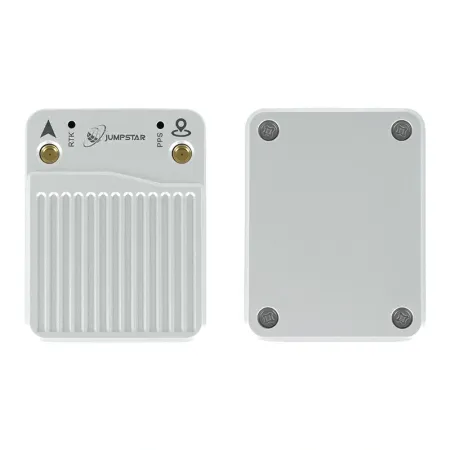
The JS-RK43-3 packages a dual-band L1+L5 receiver with 200 acquisition and tracking channels and a co-designed antenna in one housing built for unmanned aircraft. RTK accuracy is specified at 1.0 cm + 1 ppm with average current draw around 58 mA at 5.0 V, and it operates in both rover and base modes — one part serves as a drone's rover or a crew's local base station.
Because the antenna and receiver are calibrated together, the module removes the antenna-matching and layout work that normally delays RTK integrations. Its field performance is documented in the case study centimeter-level precision with JS-RK43-3.
JS-ANK45-2: High-Channel RTK for Industrial Platforms
The JS-ANK45-2 brings 1408 super channels and multi-constellation tracking to demanding industrial applications, delivering 1.5 cm + 1 ppm horizontal and 2.0 cm + 1 ppm vertical accuracy with typical RTK initialization under five seconds. Its channel-rich front end tracks all visible satellites simultaneously, which pays off under partial sky occlusion and near reflective surfaces.
For machine control, construction automation and robotics where the antenna sits low and the environment is cluttered, the channel budget translates directly into faster fixes and longer holds.
JS-UK43: Integrated-Antenna RTK All-In-One
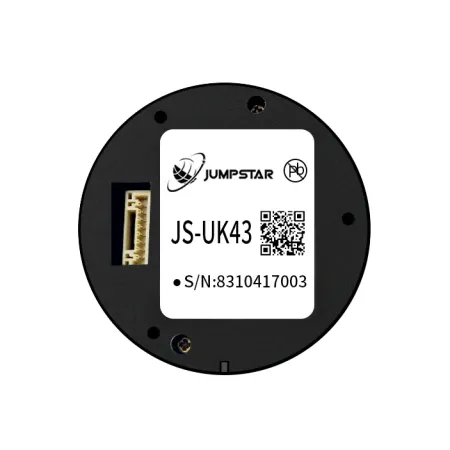
The JS-UK43 is a multi-band, multi-mode RTK positioning module with an integrated antenna and low power consumption. It pairs 192 search channels and 60 tracking channels with −167 dBm tracking sensitivity, supporting full-constellation concurrent reception while still achieving centimeter-level RTK. The integrated design suits products where a separate antenna and its cabling are a liability — handheld devices, compact rovers and embedded OEM platforms.
Its combination of high sensitivity and centimeter accuracy covers the awkward middle ground: applications that need RTK-grade results but cannot spare the space, weight or installation effort of a discrete antenna.
| Model | Bands / Channels | RTK Accuracy | RTK Init | Best Fit |
|---|---|---|---|---|
| JS-RK43-3 | L1+L5 dual-band, 200 ch | 1.0 cm + 1 ppm | Rover + base, ~58 mA | UAVs, mapping, base stations |
| JS-ANK45-2 | 1408 super channels | 1.5 cm + 1 ppm | <5 s typical | Machine control, robotics |
| JS-UK43 | 192 + 60 ch, −167 dBm | Centimeter-level | Integrated antenna | Handheld, compact rovers, OEM |
How to Choose the Right RTK Module for Your Project
1. Define the motion profile. A surveying rover walks slowly and can tolerate two-second initialization; a UAV mapping corridor needs fast re-convergence after every turn; a construction machine vibrates and needs a channel-rich receiver that holds fix. Choose the module that matches the dynamics, not the most accurate-looking number.
2. Plan the correction source. Network RTK (NTRIP) services, private base stations and local CORS networks differ in coverage, latency and cost. Confirm the RTCM3 stream format and baud rate your module accepts, and verify the region's correction availability before committing.
3. Decide antenna strategy. An integrated-antenna RTK module like the JS-RK43-3 or JS-UK43 removes matching, cabling and connector losses. A discrete antenna buys flexibility — bigger antenna, better placement — at the cost of integration work and a matched GNSS antenna.
4. Check power and thermal budgets. RTK processing draws current continuously while the receiver is in fix mode. For battery platforms, low-draw modules such as the JS-RK43-3 at 58 mA materially extend mission time.
5. Evaluate the supplier's engineering depth. Firmware customization, reference designs and responsive support determine integration speed. JUMPSTAR's OEM and ODM capabilities are described in why teams choose JUMPSTAR as a GNSS partner.
RTK Module Integration Challenges and How to Avoid Them
Correction-link reliability. The most common RTK failure is not the receiver but the correction feed. NTRIP streams drop, radio links fade and network latency spikes at the worst moment — during a row turn or a survey traverse. Design the system with buffering, reconnection logic and an explicit fix-state indicator so the host knows when the solution is centimeter-grade and when it has degraded. A module that reports fix status cleanly saves hours of field debugging.
Antenna placement. The RTK module computes the position of its antenna phase center, not the module itself. On a drone, an antenna in the propeller wash or shielded by the airframe loses low-elevation satellites exactly when the vehicle banks; on a rover, an antenna low on the body picks up multipath from the ground. Model the antenna location as part of the mechanical design and add the lever-arm offset to the position output so the host knows where the measurement point actually is.
Electrical and thermal design. RTK processing draws sustained current, and the module's power supply must stay clean under motor or actuator load. Ground bounce and supply droop during high-current events can interrupt RF performance exactly when the platform is maneuvering hardest. Provide bulk decoupling near the module, keep the RF section away from switching supplies and heat sources, and validate cold-start and re-acquisition behavior across the operating temperature range — convergence time lengthens as the receiver ages thermally, and a margin of extra fix time in the specification pays back in the field.
Firmware and configuration management. RTK modules expose many knobs — baud rates, message output rates, correction-port routing, constellation toggles — and a misconfigured parameter silently degrades performance. Version the module firmware together with the host software, ship a known-good configuration template, and test upgrades on a bench rig before rolling them out to the fleet. Teams that treat the RTK module as a configurable subsystem rather than a fixed part consistently report shorter field-issue resolution times.
Beyond the module itself, plan the surrounding system: the telemetry link that carries corrections, the power budget for continuous RTK operation, and the post-processing path for missions where live corrections fail. A complete RTK system design also budgets for field support — knowing how to interpret fix-status messages and re-initialize after a lost link is what keeps an autonomous fleet running instead of parked. Teams that document these procedures alongside the module datasheet consistently report shorter mean time to resolution when a platform reports degraded accuracy, because the diagnosis starts from the known-good configuration instead of from scratch.
Frequently Asked Questions
How accurate is an RTK module?
A fixed RTK solution typically achieves 1–2 cm horizontal accuracy plus a small baseline-dependent term (about 1 ppm). JUMPSTAR modules specify figures from 1.0 cm + 1 ppm upward depending on model.
Does an RTK module need a base station?
It needs a correction source. That can be a local base station you operate, a network RTK service delivered over the internet via NTRIP, or a public CORS network — the module itself only requires an RTCM3 correction stream.
What is the difference between RTK and PPK?
RTK applies corrections in real time over a live link; PPK records raw measurements and applies corrections after the mission. RTK suits applications needing immediate positions; PPK suits missions where the link is unreliable, such as long UAV flights. See the detailed RTK versus PPK guide.
Why is dual-band reception important for RTK?
Dual-band reception cancels most ionospheric delay and gives the ambiguity-resolution engine two frequencies to work with, which shortens convergence from minutes to seconds and improves fix reliability in dynamic conditions.
Can an RTK module work without a network connection?
Yes — RTK only needs corrections, which can arrive over radio, Wi-Fi or even serial from a nearby base. Network RTK is one delivery method, not a requirement. For offline missions, PPK post-processing achieves comparable accuracy without any live link.
Key Takeaways
- An RTK module reaches centimeter accuracy by applying real-time corrections to carrier-phase measurements — the rover side of the RTK equation, in an embeddable package.
- Dual-band reception, channel count, initialization time and correction interfaces predict real-world RTK performance better than headline accuracy.
- JUMPSTAR spans the range: JS-RK43-3 for UAV-grade integrated RTK, JS-ANK45-2 for channel-rich industrial platforms and JS-UK43 for compact integrated-antenna designs.
- Match the module to the motion profile and correction environment, and validate antenna strategy, power and supplier support before freezing the design.
Build a Centimeter-Level Product with an RTK Module
Request RTK module datasheets, evaluation kits or a review of your correction and antenna plan — the JUMPSTAR team supports UAV, robotics and industrial integrations.
Contact JUMPSTAR about RTK ModulesFeatured Products
Collection about Jumpstar
User Reviews
What users say about Jumpstar
Frequently Asked Question
Do you have any question?
An RTK module is a GNSS receiver that applies real-time corrections from a base station or network service to carrier-phase measurements, achieving centimeter-level accuracy instead of the meter-level accuracy of standard GNSS.
Fixed RTK solutions typically deliver 1-2 cm horizontal accuracy plus about 1 ppm per kilometer of baseline. JUMPSTAR modules range from 1.0 cm + 1 ppm to 1.5 cm + 1 ppm depending on model.
It needs a correction source, which can be a local base station, a network RTK (NTRIP) service or a public CORS network. The module only requires an RTCM3 correction stream to reach centimeter accuracy.
RTK applies corrections live over a data link; PPK records raw measurements and applies corrections after the mission. RTK suits real-time applications, PPK suits missions with unreliable links such as long UAV flights.
Dual-band reception cancels most ionospheric error and gives the ambiguity-resolution engine two frequencies, shortening convergence from minutes to seconds and improving fix reliability in dynamic conditions.