



Modern Global Navigation Satellite Systems (GNSS) have evolved far beyond the single-frequency L1 signals that powered early civilian GPS applications. Today's high-precision receivers leverage multiple frequency bands across multiple satellite constellations, enabling centimeter-level accuracy through advanced ionospheric correction and multipath mitigation techniques.
This article explains the technical fundamentals of the L1, L2, and L5 frequency bands, how they interact with the Earth's atmosphere, and why multi-band architecture has become essential for professional positioning applications ranging from autonomous vehicles to precision agriculture.
The L1 Band: Foundation of Civilian GNSS
The L1 band, centered at 1575.42 MHz, has been the backbone of civilian GNSS since the 1980s. Every operational GNSS constellation, including GPS, Galileo, BeiDou, and GLONASS, transmits signals in this frequency range, making it the most universally supported band for navigation receivers.
- Signal Structure: L1 carries both the C/A (Coarse/Acquisition) code for standard positioning and, on modern satellites, the L1C signal designed for improved weak-signal tracking and multi-path resistance.
- Ionospheric Vulnerability: As a single-frequency signal, L1 is subject to ionospheric delay, signal slowing caused by free electrons in the upper atmosphere, which introduces meter-level positioning errors that vary with time of day and solar activity.
- Multipath Sensitivity: L1's relatively long chip rate (1.023 MHz for C/A code) makes it susceptible to multipath interference from reflected signals, particularly in urban environments.
Understanding L1's limitations is the first step toward appreciating why multi-band receivers represent such a dramatic leap forward in positioning technology.
The L2 Band: Dual-Frequency Ionospheric Correction
The L2 band, centered at 1227.60 MHz, was historically reserved for military P(Y) code users. With the modernization of GPS and the emergence of Galileo and BeiDou, civilian-accessible signals on L2, such as L2C and the Galileo E5b component, have become available, enabling true dual-frequency positioning for professional applications.
The critical advantage of L2 lies in ionospheric error elimination. Because ionospheric delay is frequency-dependent, receivers tracking both L1 and L2 can mathematically model and subtract the delay, reducing what was once a 2-15 meter error source to under 2 centimeters. This dual-frequency correction is the foundation of all high-precision RTK and PPP positioning systems.
The L5 Band: The Future of Safety-Critical Applications
L5, centered at 1176.45 MHz, represents the next generation of GNSS signals, designed specifically for safety-of-life applications including aviation and autonomous transportation. Its higher chipping rate (10.23 MHz), wider bandwidth, and advanced modulation scheme provide inherent advantages over legacy signals.
- Superior Multipath Resistance: L5's sharper correlation peak discriminates between direct and reflected signals with far greater precision, reducing urban positioning errors by up to 50% compared to L1-only receivers.
- Higher Transmit Power: Modern satellites broadcast L5 at approximately 3dB higher power than L1, improving indoor and foliage penetration for challenging environments.
- Interference Robustness: L5's spectral separation from L1 and L2 provides frequency diversity against narrowband interference and jamming threats.
Multi-Constellation Synergy
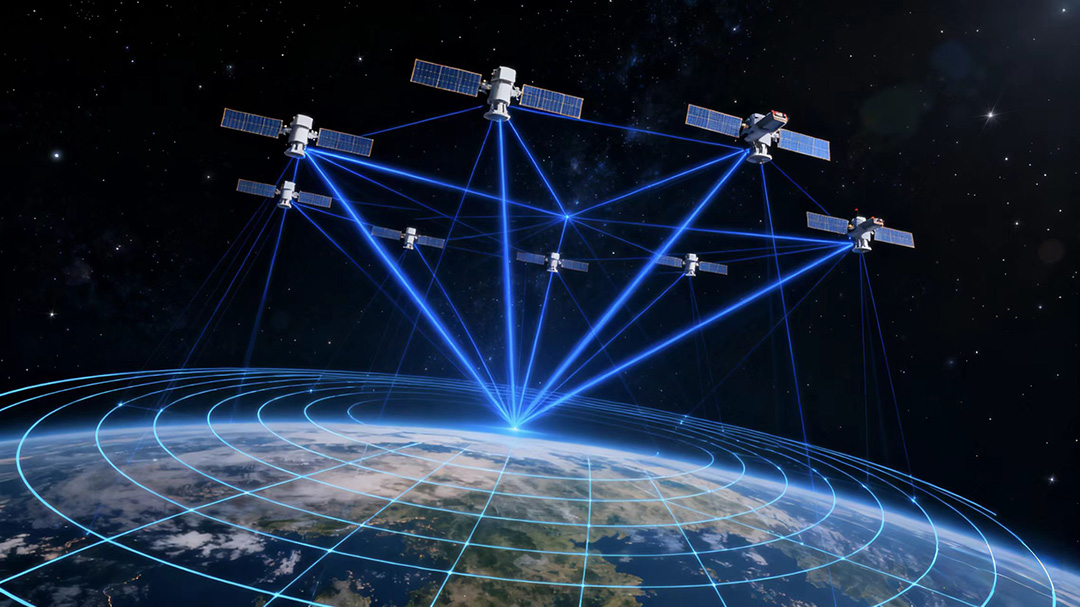
Modern professional receivers do not merely track multiple frequencies; they simultaneously track multiple constellations. A receiver supporting GPS, Galileo, BeiDou, and GLONASS can access 100+ visible satellites in open sky, ensuring that even in partial sky obstruction, sufficient signals remain available for RTK fix.
For system designers, the message is clear: single-frequency, single-constellation architectures are obsolete for professional applications. Multi-band, multi-constellation receivers are no longer a premium option; they are the baseline for reliable centimeter-level positioning.
.png?imageMogr2/format/webp)
.png?imageMogr2/format/webp)