

When designing a high-precision GNSS system, one of the earliest and most consequential decisions is the choice between Real-Time Kinematic (RTK) and Post-Processed Kinematic (PPK) correction methodologies. Both techniques achieve centimeter-level accuracy by resolving carrier-phase ambiguities, but they differ fundamentally in workflow, infrastructure requirements, and application suitability.
This article provides a technical comparison of RTK and PPK, examining their underlying principles, operational constraints, and the scenarios where each method delivers optimal results. Whether you are developing UAV surveying platforms, autonomous navigation systems, or precision agricultural equipment, understanding these differences is essential for successful system architecture.
How RTK Works: Real-Time Centimeter Accuracy
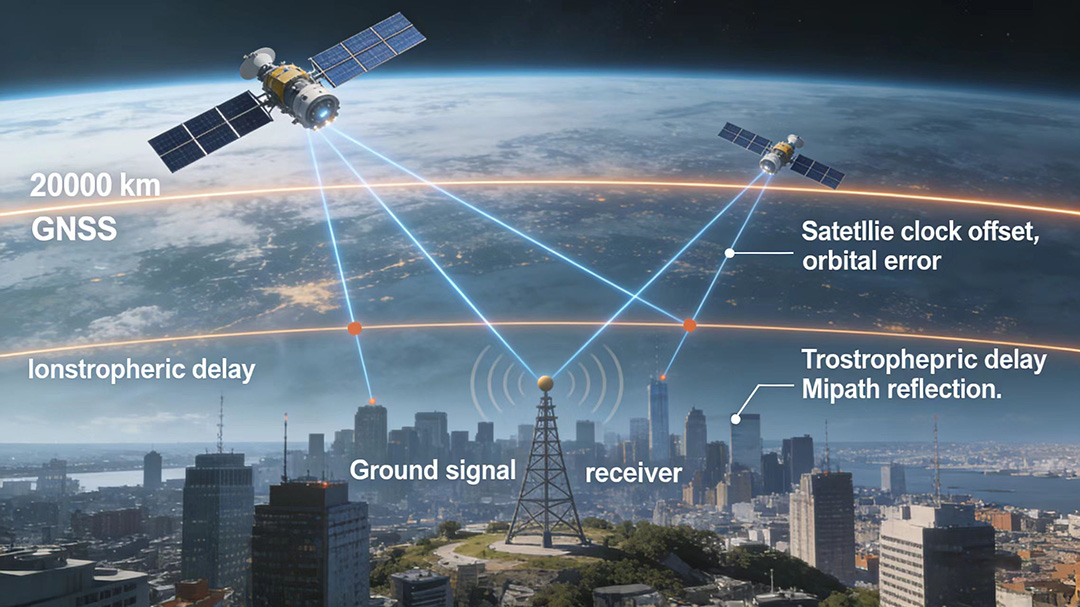
RTK operates by transmitting correction data from a stationary base station to a mobile rover in real time, typically via radio modem, cellular network, or satellite link. The base station calculates error components, ionospheric delay, tropospheric delay, satellite clock and ephemeris errors, and broadcasts these as differential corrections. The rover applies these corrections to its own measurements, enabling instantaneous centimeter-level positioning.
- Latency Sensitivity: RTK performance degrades as correction latency increases. Most applications require corrections delivered within 1-2 seconds to maintain optimal accuracy.
- Communication Dependency: Continuous data link between base and rover is mandatory. Link outages exceeding a few seconds typically cause the rover to lose its RTK fix and revert to less precise differential or standalone positioning.
- Infrastructure Requirements: RTK requires either a local base station with radio coverage or subscription to an NTRIP correction network providing cellular or internet connectivity.
- Use Case Fit: Ideal for applications requiring immediate position feedback, such as autonomous steering, UAV real-time navigation, and construction machine control.
RTK transforms GNSS from a navigation aid into a real-time control signal. The moment you need a machine to act on position data, steer, trigger, or correct, RTK becomes the only viable option.
How PPK Works: Accuracy Without Real-Time Constraints
PPK takes a fundamentally different approach. Both the base station and rover independently record raw GNSS measurements, including pseudoranges, carrier phases, and Doppler observations, without any real-time communication between them. After the mission concludes, these data files are combined in post-processing software that solves for the rover's trajectory with centimeter-level precision.
- No Communication Link: Because base and rover do not communicate during operation, PPK works in environments with no radio or cellular coverage, including remote survey areas and over-water operations.
- Higher Fix Rate: Post-processing software can apply sophisticated forward-backward smoothing algorithms and multi-epoch ambiguity resolution techniques that often achieve higher fix rates than real-time RTK under challenging conditions.
- Workflow Overhead: PPK introduces a processing step between data collection and result delivery. For time-critical applications, this delay may be unacceptable.
- Use Case Fit: Preferred for aerial photogrammetry, hydrographic surveying, and any application where the final position is needed hours or days after collection rather than instantaneously.
Decision Framework for System Designers
The choice between RTK and PPK is rarely absolute; many modern receivers support both modes, allowing operators to select the appropriate method for each mission. However, primary mode selection should be guided by the application's real-time requirements, communication infrastructure, and operational workflow constraints.
For autonomous systems requiring closed-loop control, RTK is mandatory. For mapping and surveying where data can be processed after the fact, PPK often delivers superior accuracy with simpler field logistics. Understanding your application's position-to-action latency requirements is the key to making the right choice.
.png?imageMogr2/format/webp)
.png?imageMogr2/format/webp)