




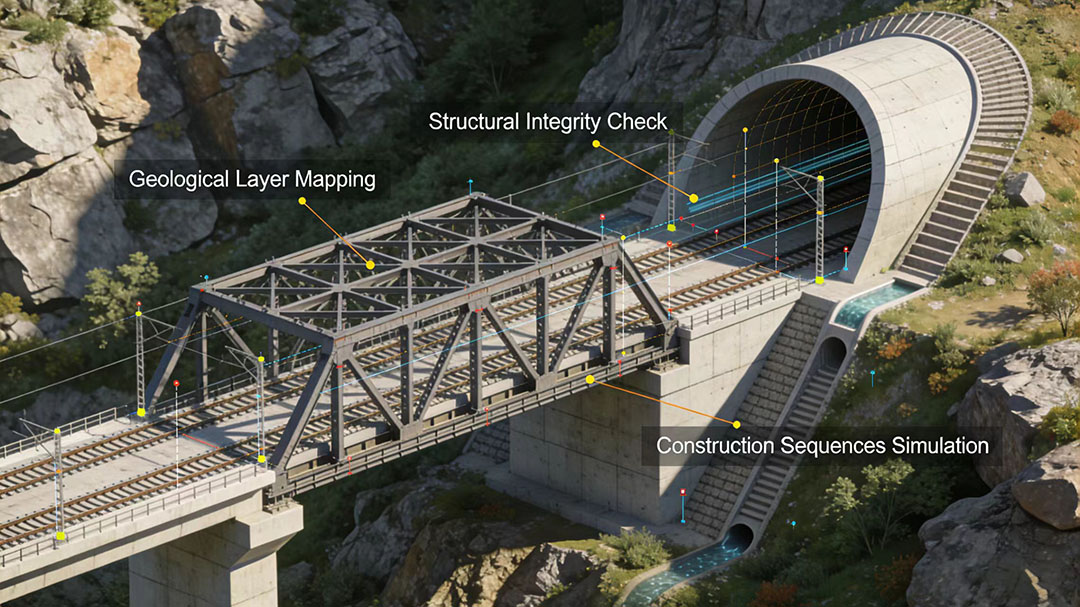
Every GNSS receiver, regardless of sophistication, shares a common vulnerability: it requires a clear line of sight to satellites. When that line of sight is interrupted, by tunnels, parking garages, dense urban canyons, or intentional jamming, positioning accuracy degrades rapidly or fails entirely. For autonomous vehicles, delivery drones, and safety-critical navigation systems, these gaps are unacceptable.
The solution lies in sensor fusion: tightly coupling GNSS receivers with Inertial Measurement Units (IMUs) to create a navigation system that remains accurate during extended satellite signal outages. This article examines the technical principles of GNSS/IMU fusion, the difference between loose and tight coupling architectures, and the performance characteristics that matter for real-world applications.
Understanding IMU Drift and Why Fusion is Necessary
An IMU measures specific force and angular rate using accelerometers and gyroscopes. By integrating these measurements over time, a navigation system can compute position, velocity, and attitude without any external references. However, this integration process accumulates errors; small biases in the sensors compound into rapidly growing position errors, a phenomenon known as drift.
- Accelerometer Bias: A tiny bias of 100 micrograms (one ten-thousandth of gravity) integrates into a position error of approximately 18 meters after just 60 seconds of pure inertial navigation.
- Gyroscope Bias: A gyro bias of 1 degree per hour causes the attitude solution to tilt, misprojecting gravity into the horizontal plane and creating fictitious acceleration that rapidly corrupts position estimates.
- The Role of GNSS: GNSS provides absolute position fixes with bounded error, making it the perfect complement to IMU-based dead reckoning. The challenge is designing the fusion architecture to maximize the strengths of both sensors.
An IMU alone is blind within minutes. GNSS alone is blind under cover. Together, properly fused, they create a navigation system that is robust in almost any environment Earth can offer.
Loose Coupling vs. Tight Coupling
GNSS/IMU fusion systems are categorized by how deeply the sensors interact. The architectural choice has profound implications for performance during partial and complete GNSS outages.
Loose Coupling treats GNSS and IMU as independent sensors, feeding their position and velocity outputs into a Kalman filter. While simple to implement, this architecture fails entirely when GNSS drops below four visible satellites, the minimum required for a standalone position fix, even if raw pseudorange and carrier-phase measurements from fewer satellites could still constrain the IMU solution.
Tight Coupling operates at the measurement level, feeding raw GNSS pseudoranges, Doppler measurements, and carrier phases directly into the navigation filter alongside IMU data. Even with only one or two visible satellites, the system can partially constrain position drift, dramatically extending outage tolerance.
Real-World Performance Benchmarks
Jumpstar's tightly coupled GNSS/IMU modules have been tested in real-world scenarios that challenge pure GNSS systems. In highway tunnel sequences with 45-second signal outages, tight coupling maintained horizontal position accuracy within 0.5 meters, compared to loose coupling errors exceeding 10 meters and pure IMU errors exceeding 50 meters.
For autonomous vehicle developers, these performance differences translate directly into safety margins. A system that maintains sub-meter accuracy through a tunnel can continue lane-keeping and adaptive cruise control without driver intervention. A system that drifts 10 meters poses an immediate safety hazard.
When evaluating GNSS modules for applications where signal outages are inevitable, tight coupling is not an optional enhancement; it is a fundamental requirement for safe and reliable operation.
.png?imageMogr2/format/webp)
.png?imageMogr2/format/webp)