





During GNSS development, a receiver that reports an accurate position is only part of the story. Many projects also need to know when something happened relative to GNSS time, and how well the GNSS system correlates with external events, sensors or equipment. An event-based GNSS evaluation kit is a way to test exactly that.
Evaluation kits support early-stage GNSS technology evaluation, hardware and software integration, signal and timing validation, and application-specific testing before a design is locked in. This guide explains what event-based evaluation involves, how it works, and what engineers should check when selecting a kit.
What Is an Event-Based GNSS Evaluation Kit?
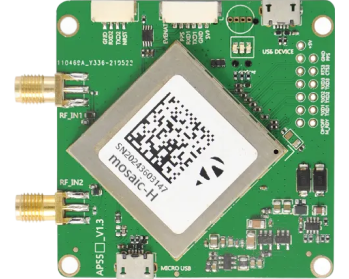
A GNSS evaluation kit is a hardware and software package that lets engineers run a GNSS receiver outside the final product, often with a development board, antenna, interface breakout and configuration tools. The purpose is to measure real behavior in a controlled setup rather than relying on datasheet values alone.
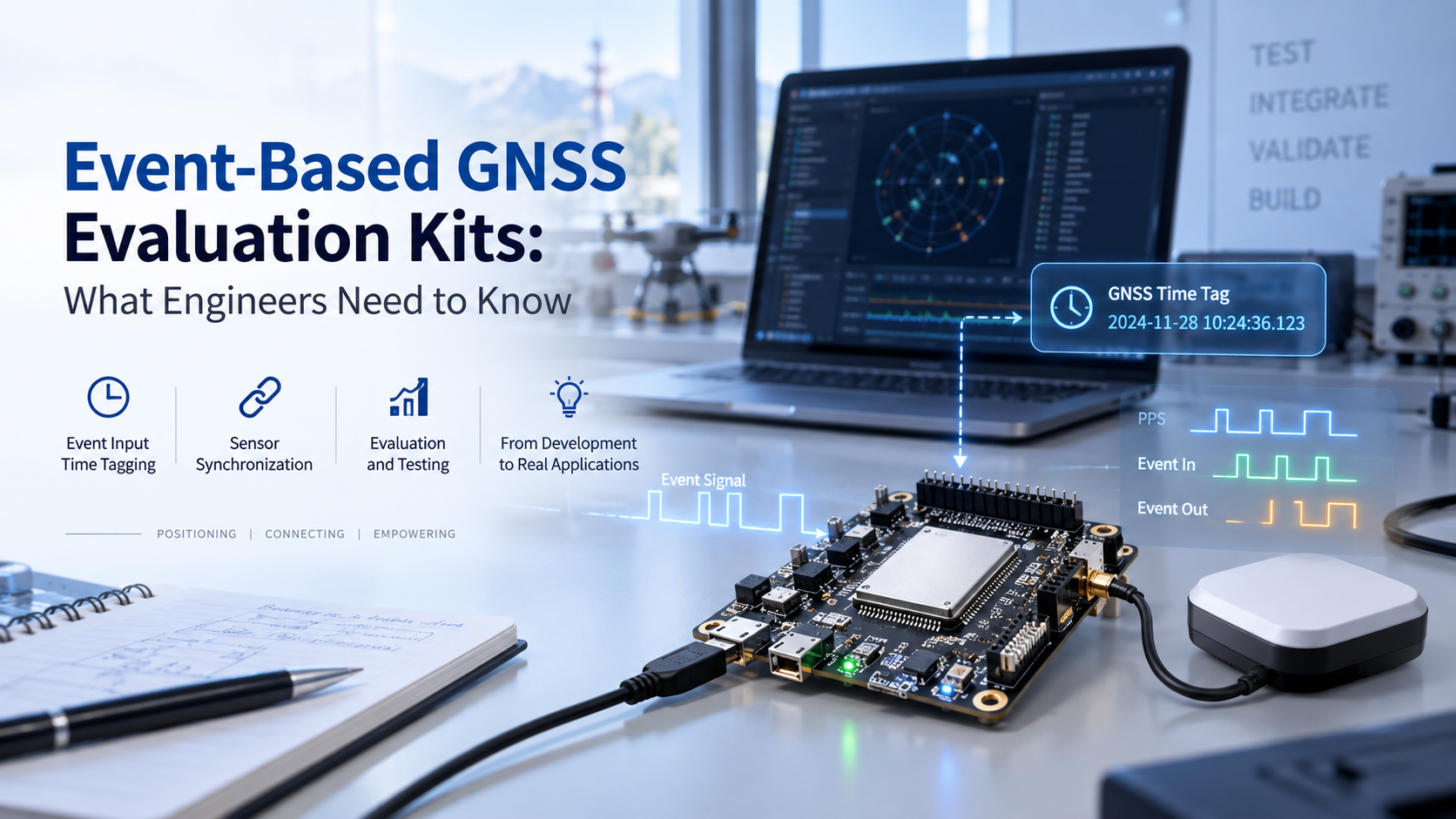
An event input is a discrete signal, typically an electrical pulse, that the GNSS system accepts from an external device. The source might be a camera shutter, a LiDAR, a sensor output or a controller signal. When the system detects that signal, it can associate the event with a GNSS-derived time reference. That association is usually called time tagging, and the recorded marker itself is often referred to as an event marker.
The difference from a standard positioning test is the focus. Conventional evaluation asks how well the receiver positions. Event-based evaluation asks how well the receiver positions and how reliably it relates that positioning and timing to the rest of the system. It is a system-integration question as much as a positioning question.
One practical caution: event input, event marking and time tagging are common capabilities across the GNSS industry, but they are not universal. Whether a specific kit supports them, and in what form, must be confirmed against that product's own documentation and vendor specifications.
How Does Event-Based GNSS Evaluation Work?
The underlying workflow is straightforward at the engineering level:
- An external event signal is generated by the device under test or by surrounding equipment.
- The GNSS evaluation system detects or records the event through its event input.
- The event is associated with a GNSS-derived time reference.
- Engineers analyze the timing or positioning relationship between the two.
- The results are used to evaluate system integration and to decide whether the architecture is viable.
Two concepts appear repeatedly in this workflow. A PPS (pulse per second) output is a periodic timing signal aligned to GNSS time, commonly used as a synchronization reference for other equipment. An event marker records a specific moment, usually triggered by an external input, so it can be compared later against logged position and time data.
The engineering detail worth confirming with any vendor is not whether the concepts exist, but how they are implemented: what signal levels the event input expects, what latency or resolution applies, how the event is represented in the data output, and whether the logged record can be matched against position fixes. These are specification-level questions best answered from official documentation.
Potential Applications of Event-Based GNSS Evaluation
The following are general engineering scenarios where event correlation and GNSS timing commonly matter:
- UAV and drone development: Flight controllers log multiple streams at once, and engineers may want to confirm how GNSS time aligns with flight events and sensor records.
- Robotics and autonomous systems: Mobile platforms combine GNSS with perception sensors, and event-based evaluation helps verify that these inputs stay consistent in time.
- Surveying and mapping equipment: Mapping workflows may need to associate a measurement or image with a precise moment, which makes event marking relevant.
- Industrial sensing and synchronization: Distributed equipment sometimes requires a shared time reference, and GNSS timing can serve as that reference.
- Camera and sensor event correlation: In a general design pattern, a camera or sensor trigger is time-tagged against GNSS so that imagery or measurements can be tied to a position and moment.
- GNSS-based timing and data collection: Long-duration logging benefits from a consistent time base across recorded datasets.
These examples describe technical relevance only. Whether a given architecture is suitable depends on the project's own accuracy, interface and environmental requirements.
Key Features Engineers Should Evaluate
- Supported GNSS constellations and frequency bands: Which systems and bands the receiver tracks, and whether that matches the target market's coverage needs.
- Event input compatibility: Signal type, level and connector expectations of any external trigger input.
- Timing and timestamp behavior: How events are timestamped, what time base is used, and how the record is stored or reported.
- Available communication interfaces: UART, USB, Ethernet, CAN or other ports, and which ones are exposed on the kit.
- Data output and logging options: Whether raw observations, position solutions and event records can be captured for later analysis.
- Evaluation software and documentation: Configuration tools, protocol references and sample workflows that shorten ramp-up time.
- Hardware compatibility: Antenna requirements, power supply range and mechanical fit with the intended product.
- Ease of integration and debugging: Accessible test points, status indicators and clear error reporting make development iterations faster.
Vendor documentation is the only reliable source for these points. Product names rarely indicate whether an event input exists or how timing is handled.
Event-Based GNSS Evaluation vs. Standard GNSS Evaluation
| Evaluation Focus | Standard GNSS Evaluation | Event-Based Evaluation |
|---|---|---|
| Positioning performance | Core focus | May also be evaluated |
| External event correlation | May be limited | Important consideration |
| Timing analysis | Depends on the kit | Often a key objective |
| System integration | Receiver-level testing | Receiver and external-system interaction |
This comparison describes general evaluation approaches, not the feature list of any particular product. Many kits support a mix of both, and the practical split depends on how the kit is wired and configured.
How to Select the Right GNSS Evaluation Kit
- Define the target application: Positioning-only testing and system-level event testing call for different kit configurations.
- Identify required GNSS signals and accuracy: Match constellation, band and positioning-mode needs to the project's real requirements.
- Confirm event input and timing requirements: Establish the trigger signal, expected timing behavior and how results will be validated.
- Check interfaces and development tools: Make sure the ports, adapters and configuration software fit the existing development environment.
- Review documentation and integration resources: Datasheets, protocol descriptions and application notes reduce integration risk.
- Verify availability and technical support: Confirm lead time and whether engineering support is available during evaluation.
- Test against actual system requirements: Validate the kit under the conditions the final product will face, not only on a bench.
The recurring theme is verification: decisions should follow confirmed specifications and measured results rather than assumptions based on a product name.
Evaluating JUMPSTAR GNSS Hardware for Event-Based Applications
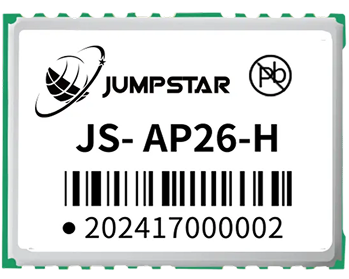
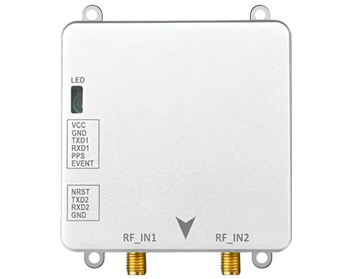
JUMPSTAR's public product structure includes an Evaluation Kits / EVK category within its Accessories & Evaluation Kits range, positioned for rapid prototyping and RF evaluation, alongside GNSS modules, high-precision RTK modules, timing modules and GNSS OEM boards.
Publicly available materials do not identify a dedicated event-based evaluation kit with published event-input specifications. Engineers therefore need to confirm suitability directly: ask the JUMPSTAR technical team whether a given evaluation kit or module exposes an external event input, how events are timestamped and reported, and which interfaces are available for logging. This is the same due-diligence step that applies to any GNSS vendor.
Conclusion
An event-based GNSS evaluation kit supports more than a positioning check: it helps engineers verify how a GNSS system relates to external events, sensors and equipment in time. Before selecting one, confirm functional compatibility, timing requirements, hardware interfaces, documentation and technical support against the actual application, not the product name.
For projects evaluating GNSS hardware for event correlation or timing work, JUMPSTAR's evaluation kits, modules and OEM boards provide a starting point, and the technical team can confirm the interface details for a specific design.
.png?imageMogr2/format/webp)
.png?imageMogr2/format/webp)