





In any GNSS-based positioning system, the antenna is the first component that interacts with satellite signals. A well-designed receiver paired with a poorly chosen antenna will deliver disappointing results—no matter how advanced the positioning engine. For engineers and procurement professionals evaluating GNSS antenna types for integration projects, understanding the relationship between antenna design and system performance is essential.
Different antenna architectures—patch, helical, and high-precision multi-band—each serve distinct use cases. Selecting the wrong type leads to degraded signal reception, reduced positioning accuracy, and unreliable operation in challenging environments. This guide explains the main GNSS antenna categories, their engineering tradeoffs, and how to match them to your application requirements.
Why GNSS Antenna Selection Matters
The antenna is often treated as an afterthought in positioning system design. In practice, it determines the quality of every signal the receiver processes. Several factors make antenna selection a critical engineering decision:
Signal Quality at the Source. The antenna's gain, noise figure, and axial ratio directly affect the carrier-to-noise density ratio (C/N₀) that reaches the receiver. A weak signal at the antenna input cannot be recovered by downstream processing.
Frequency Band Coverage. Single-band L1 antennas are adequate for basic positioning. Multi-band L1/L2/L5 antennas enable RTK centimeter-level accuracy by providing the dual-frequency measurements needed for ionospheric correction.
Phase Center Stability. For high precision GNSS antenna applications, millimeter-level phase center variation (PCV) is essential. Instability introduces position errors that compromise survey-grade accuracy.
Environmental Resilience. Antennas operating outdoors must withstand temperature extremes, moisture, vibration, and multipath interference from nearby structures.
Satellite Constellation Support. GPS-only reception is no longer sufficient. Modern GNSS antenna selection must consider concurrent tracking of GPS, BDS, GLONASS, Galileo, and QZSS for robust satellite availability.
Main Types of GNSS Antennas
GNSS antennas fall into several architectural categories, each with distinct electrical characteristics, form factors, and application suitability. Understanding these differences is the foundation of effective GNSS antenna selection.
Patch GNSS Antennas
Patch antennas are the most common GNSS antenna types found in consumer and mid-range commercial devices. Built on a ceramic substrate with a metal radiating element, they offer a compact, low-profile form factor at low cost. Their circular polarization is achieved through geometric design of the radiating patch, making them suitable for right-hand circularly polarized (RHCP) GNSS signals.
However, patch antennas have inherent limitations. Their gain pattern narrows at low elevation angles, reducing the number of satellites tracked near the horizon. Phase center stability is moderate, and multipath suppression is limited compared to more sophisticated designs. These characteristics make patch antennas appropriate for consumer navigation devices, basic asset trackers, and applications where sub-meter accuracy is not required.
Best for: Consumer terminals, basic tracking devices, handheld GNSS receivers, and cost-sensitive embedded applications where meter-level accuracy is acceptable.
Helical GNSS Antennas
Helical GNSS antenna designs provide significantly better circular polarization performance than patch antennas. Their spiral radiating structure generates a more uniform gain pattern across the upper hemisphere, delivering reliable signal reception even at low elevation angles. This characteristic is especially important for dynamic platforms—UAVs, robots, and vehicles—where antenna orientation changes continuously during operation.
Helical antennas also offer inherent multipath rejection advantages. Their wide-beam axial ratio performance helps discriminate against reflected signals, maintaining positioning integrity in environments with buildings, metal structures, and other reflective surfaces. For applications requiring stable positioning during movement, helical designs outperform patch antennas across multiple performance dimensions.
Best for: UAVs and drones, robotics, dynamic vehicle positioning, maritime navigation, and any application where consistent signal reception during motion is critical.
.png?imageMogr2/format/webp)
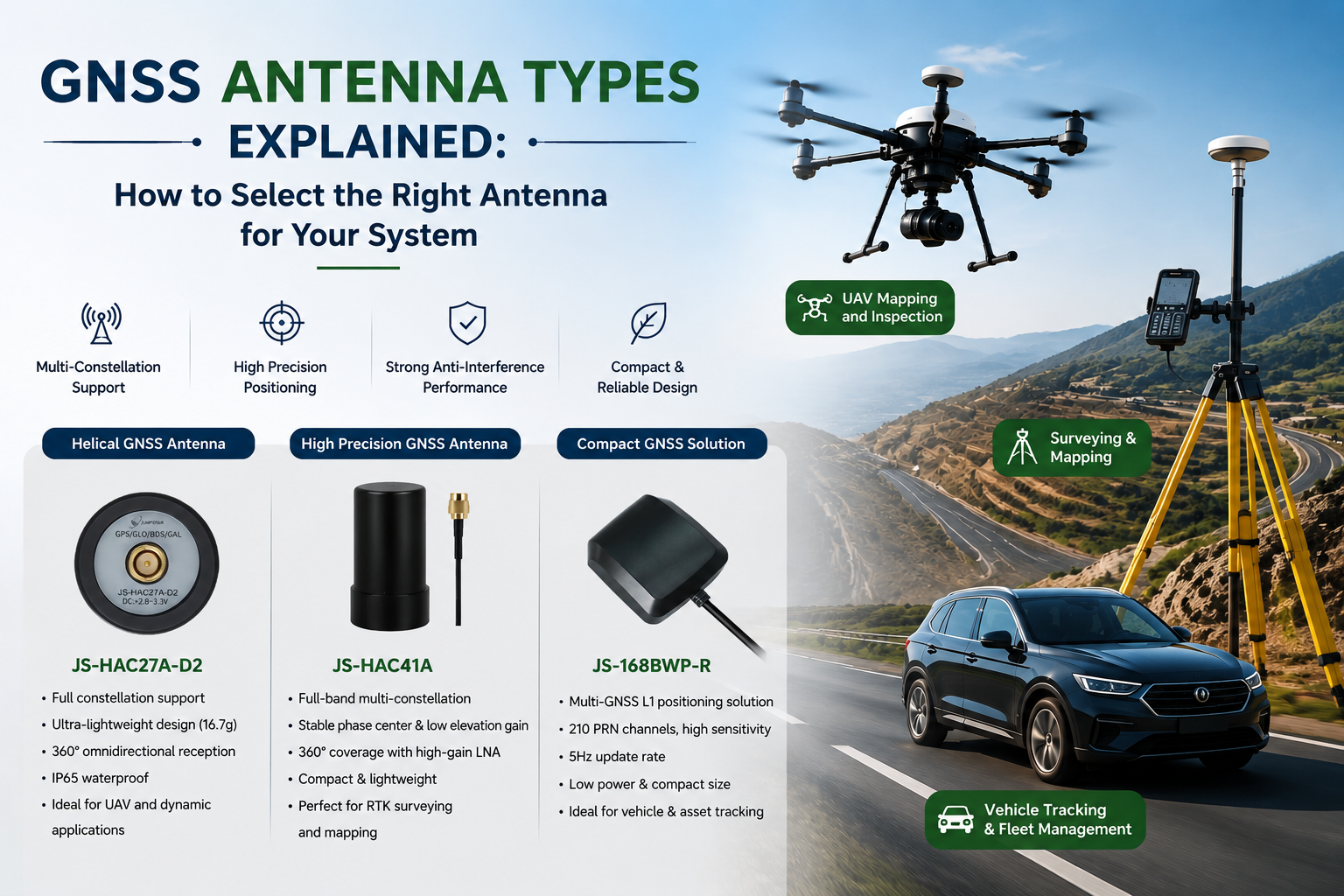
JUMPSTAR JS-HAC27A-D2 — Lightweight UAV Helical GNSS Antenna
Designed specifically for lightweight UAV platforms, the JS-HAC27A-D2 combines full-constellation L1/L2/L5 reception with an ultra-lightweight 16.7 g form factor. Its 360° omnidirectional coverage eliminates receiving blind spots, while the anti-interference helical design maintains positioning stability in complex RF environments.
High Precision GNSS Antennas
When applications demand survey-grade accuracy—RTK positioning, geodetic surveying, precision agriculture, and infrastructure monitoring—a high precision GNSS antenna becomes non-negotiable. These antennas are engineered with tightly controlled phase center stability, multi-band reception across all operational GNSS frequencies, and optimized low-elevation gain performance.
The defining characteristic of a high-precision antenna is millimeter-level phase center repeatability. In RTK processing, centimeter-level positioning requires the antenna to behave as if it receives all signals from a single, fixed point in space—regardless of satellite elevation or azimuth. Any deviation introduces systematic errors that propagate through the positioning solution.
An RTK antenna must also support L1, L2, and ideally L5 frequency bands simultaneously. This multi-band capability enables dual-frequency and triple-frequency RTK algorithms to resolve carrier-phase ambiguities rapidly and correct for ionospheric delay—the dominant error source in single-frequency positioning.
.png?imageMogr2/format/webp)
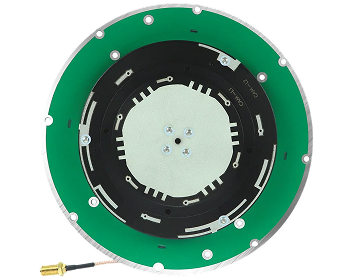
JUMPSTAR JS-HAC41A — Full-Band Multi-Constellation High Precision Antenna
The JS-HAC41A covers all major GNSS frequency bands—GPS L1/L2/L5, BDS B1I/B2I/B3I, GLONASS G1/G2/G3, and Galileo E1/E5a/E5b/E6—making it suitable for RTK, PPP, and multi-frequency positioning workflows. With LNA gain of 32±2 dB and a noise figure ≤2 dB, it delivers clear signal reception across the full 360° horizontal coverage pattern. The stable phase center and excellent low-elevation gain support demanding surveying, UAV mapping, and container terminal automation applications.
Compact GNSS Solutions for Vehicle and Fleet Applications
Fleet tracking, logistics dispatch, and vehicle positioning systems have requirements that differ from high-precision or UAV applications. These systems prioritize low power consumption, stable positioning at standard accuracy levels, and compact integration—often via an enclosed G-Mouse form factor that combines the antenna, LNA, and receiver in a single weatherproof unit.
Unlike the standalone antennas discussed above, compact GNSS positioning solutions integrate the antenna element with a complete receiver engine. This integration simplifies system design: the OEM only needs to supply power and read position data over a standard serial interface. For fleet operators managing hundreds or thousands of vehicles, this plug-and-play approach reduces integration time, field maintenance complexity, and total cost of ownership.
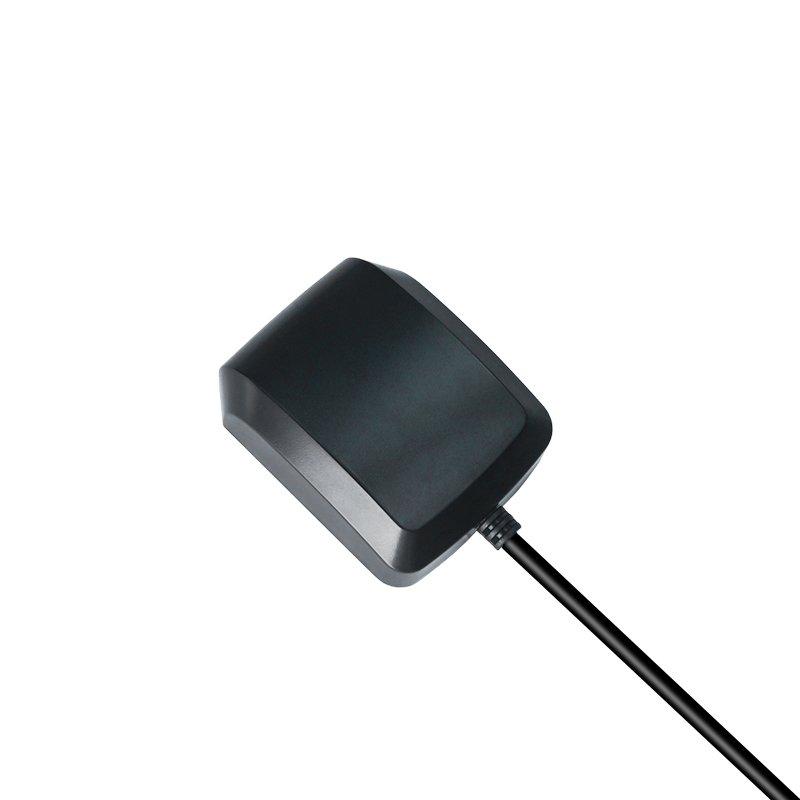
JUMPSTAR JS-168BWP-R — Multi-GNSS Compact Positioning Solution
The JS-168BWP-R is a compact G-Mouse positioning solution integrating a high-sensitivity GNSS SOC with 210 PRN channels (72 acquisition + 24 tracking). Supporting GPS+BDS or GPS+GLONASS dual-mode positioning with -162 dBm tracking sensitivity and a 5 Hz update rate, it delivers reliable performance for fleet tracking, logistics dispatch, and vehicle positioning. The integrated TCXO, LNA, SAW filter, and RTC minimize external component count, while the compact 50.2 mm × 39.2 mm × 19.2 mm housing supports space-constrained installations.
Key Factors When Choosing a GNSS Antenna
Effective GNSS antenna selection requires evaluating technical specifications against application requirements. The following factors are the most important in guiding a decision.
1. Frequency Band Support
Single-band L1 antennas are sufficient for basic positioning with 2-5 meter accuracy. Multi-band L1/L2 antennas enable dual-frequency RTK for centimeter-level accuracy by providing the second frequency needed for ionospheric correction. Adding L5 further improves signal robustness, especially for safety-critical and autonomous applications. The frequency bands your antenna supports should align with your target accuracy level.
2. Satellite Constellation Compatibility
GPS-only coverage limits satellite availability to approximately 31 operational satellites. Multi-constellation support—including BDS, GLONASS, and Galileo—increases the visible satellite count to over 100, dramatically improving position availability in urban canyons, mountainous terrain, and other challenging environments. For global deployment, select antennas that cover all major constellations.
3. Accuracy Requirements
Standard positioning (2-5 m) can be achieved with L1 patch antennas. Sub-meter accuracy (30-100 cm) requires SBAS or DGNSS correction and benefits from better antenna gain patterns. RTK centimeter-level positioning demands multi-band antennas with stable phase centers and low multipath susceptibility. Match the antenna performance class to your accuracy target—over-specifying adds unnecessary cost; under-specifying guarantees poor results.
4. Operating Environment
Environmental conditions directly influence antenna selection. Urban deployments face severe multipath from buildings; helical designs with better axial ratio provide stronger multipath rejection. Outdoor fixed installations require weatherproofing (IP65 or higher) and wide temperature tolerance. Vehicle-mounted antennas must withstand vibration and shock. UAV applications demand the lightest possible weight to minimize payload impact.
5. Size and Integration Requirements
The antenna must physically fit within the host device or mounting location. Compact modules like G-Mouse receivers simplify integration by combining the antenna, LNA, and receiver into a single unit requiring only power and a serial data connection. For custom OEM designs, standalone antennas with standard SMA connectors offer flexibility in placement and cabling. Consider power consumption, especially for battery-powered devices where every milliwatt matters.
How to Choose the Right GNSS Antenna for Different Applications
The table below maps common application categories to the most suitable GNSS antenna or positioning solution type. Use this as a starting point, then refine based on your specific accuracy, environment, and integration requirements.
JUMPSTAR GNSS Antenna and Positioning Solutions
JUMPSTAR manufactures a comprehensive range of GNSS antennas and positioning components tailored to diverse integration requirements. From ultra-lightweight helical antennas for UAV platforms to full-band high-precision antennas for survey-grade applications and compact G-Mouse receivers for fleet deployments, the product line addresses the full spectrum of positioning performance needs.
Every JUMPSTAR antenna is engineered for reliable field performance—with full-constellation support, industrial-grade environmental protection, and standardized interfaces that simplify OEM integration. Whether you are developing a drone mapping payload, an RTK surveying instrument, a fleet telematics unit, or an autonomous navigation system, selecting the right GNSS antenna type from a trusted manufacturer is the first step toward dependable positioning performance.
Frequently Asked Questions
What is the difference between a patch antenna and a helical GNSS antenna?
Patch antennas use a flat ceramic radiating element and offer compact, low-cost design, but have weaker low-elevation performance and moderate multipath rejection. Helical antennas use a spiral structure that provides better axial ratio, more uniform gain across elevation angles, and stronger multipath suppression—making them preferred for dynamic platforms like UAVs and robots.
Do I need a multi-band antenna for RTK positioning?
Yes. RTK centimeter-level positioning requires dual-frequency (L1/L2) or triple-frequency (L1/L2/L5) measurements to resolve carrier-phase ambiguities and correct for ionospheric delay. A single-band L1 antenna cannot provide the second frequency needed for RTK processing and will deliver only meter-level accuracy.
Why is phase center stability important for high-precision applications?
Phase center variation (PCV) introduces position errors that scale with satellite geometry changes. In survey-grade applications requiring 1-2 cm accuracy, even millimeter-level PCV can degrade results. High-precision antennas are designed with carefully controlled phase center characteristics to minimize this error source.
How does antenna weight affect UAV performance?
Every gram added to the payload reduces flight endurance. A lightweight antenna like the JS-HAC27A-D2 at 16.7 g minimizes the positioning payload impact, allowing longer mission times or additional sensor capacity. For small and medium UAVs, antenna weight is a critical selection parameter alongside electrical performance.
What is a G-Mouse receiver and when should I use one?
A G-Mouse is an integrated GNSS positioning solution that combines the antenna, LNA, SAW filter, and receiver engine in a single weatherproof enclosure. It outputs position data over a standard serial interface (NMEA). This plug-and-play approach is ideal for fleet tracking, logistics, and vehicle telematics where rapid integration and minimal design effort are priorities.
Can I use the same antenna for GPS, BDS, GLONASS, and Galileo?
Yes, if the antenna is designed for multi-constellation reception. Full-band antennas like the JS-HAC41A cover all major GNSS frequency allocations across GPS, BDS, GLONASS, and Galileo, enabling concurrent multi-constellation tracking for maximum satellite availability and positioning robustness.
What level of environmental protection do I need for outdoor GNSS antennas?
For permanent outdoor installations, IP65 or higher is recommended to protect against dust ingress and water jets. For UAV and mobile applications, IP65 with a properly mated connector provides adequate protection against rain and dust. Always verify the operating temperature range matches your deployment environment—industrial-grade antennas typically support -30°C to +70°C or wider.
Take the Next Step
Selecting the right GNSS antenna type is an engineering decision that directly impacts your system's positioning performance, reliability, and integration complexity. JUMPSTAR's application engineering team can help you evaluate your requirements and recommend the most suitable solution.
Ready to find the right GNSS antenna for your project?
.png?imageMogr2/format/webp)
.png?imageMogr2/format/webp)