
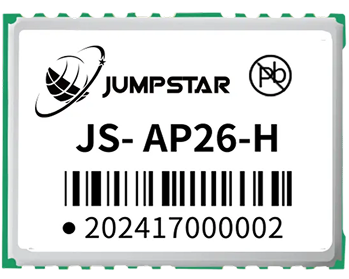
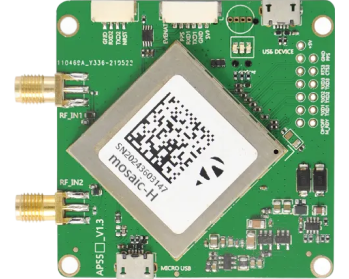
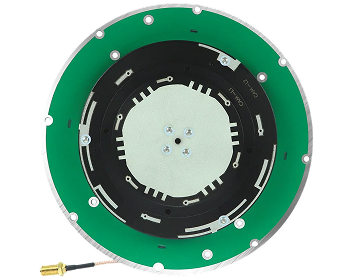
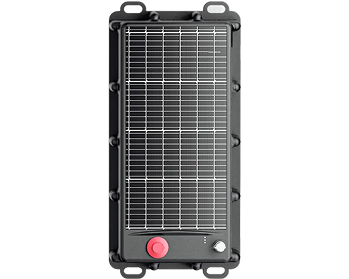





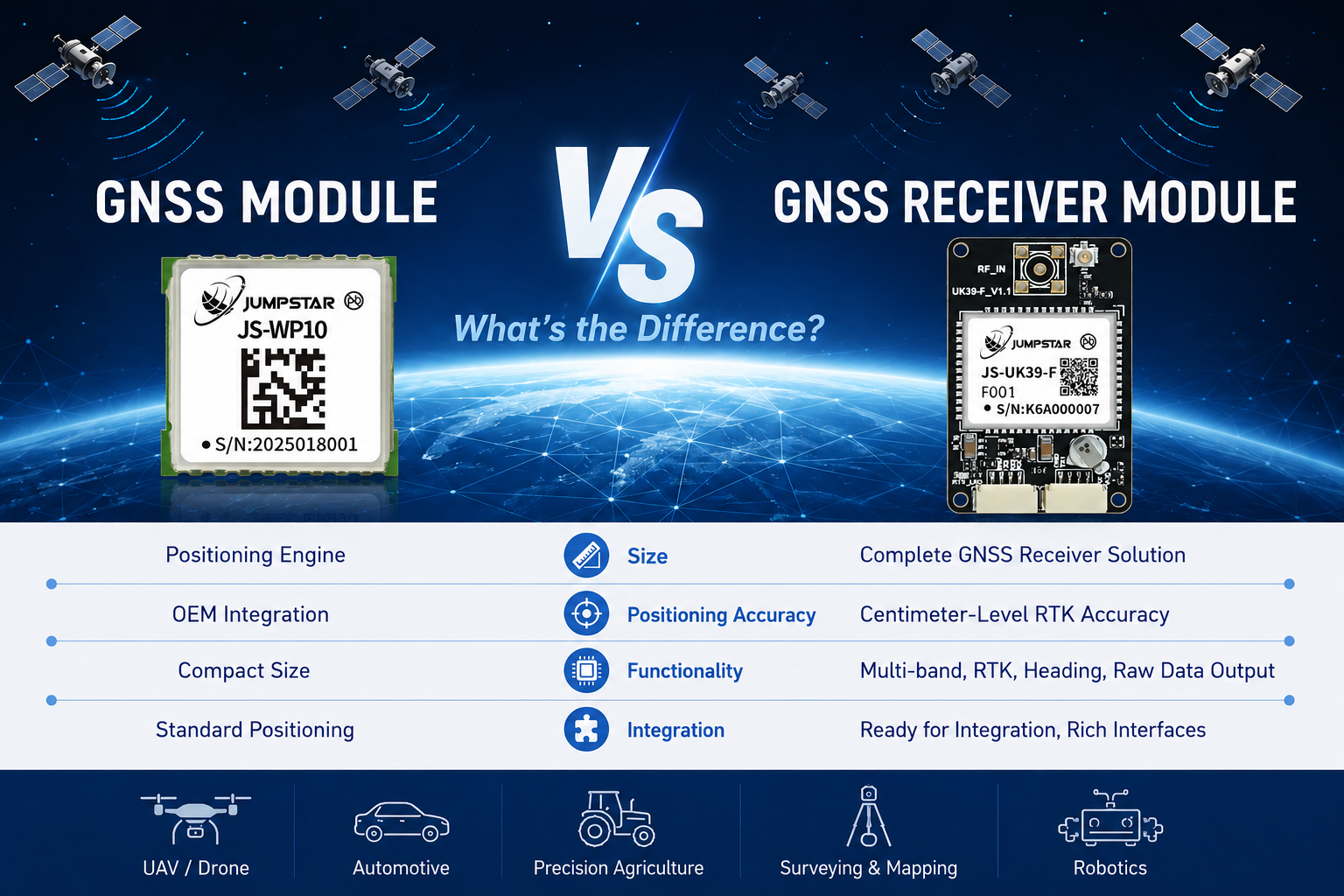
When OEM engineers and system integrators begin evaluating GNSS positioning hardware for their products, one of the first questions they encounter is this: should I use a GNSS module, or do I need a GNSS receiver module? The terms sound similar, and many suppliers use them interchangeably, but the two represent fundamentally different levels of hardware integration, signal processing capability, and positioning performance.
Choosing the wrong solution can mean over-engineering a simple tracking device with unnecessary RTK hardware, or worse, designing a precision autonomous system around a basic GNSS module that cannot deliver the accuracy the application demands. The decision affects more than just the bill of materials. It shapes your hardware design, firmware effort, power budget, product cost, and ultimately your time to market.
This article draws on real-world integration experience to explain what separates a GNSS module from a GNSS receiver module, when an RTK GNSS receiver module becomes necessary, and how to decide which level of positioning hardware fits your application. We will use concrete product examples from JUMPSTAR GNSS to ground each concept in real hardware, but the decision framework applies regardless of which supplier you ultimately choose.
What Is a GNSS Module?
A GNSS module is a compact, integrated positioning component designed for direct embedding into an OEM product. Think of it as a self-contained satellite navigation engine on a small PCB. It includes a GNSS chipset, RF front-end, and necessary passive components mounted on a single board, ready to be soldered onto the host system's main PCB or connected via a standard interface.
Key Characteristics of a GNSS Module
- Compact form factor — typically measuring under 15mm × 15mm, these modules occupy minimal board space and fit easily into space-constrained designs.
- Low power consumption — optimized for battery-powered operation, with typical current draw in the tens of milliamps during continuous tracking.
- Single-band reception — most embedded GNSS modules operate on the L1 band, providing 2–3 meter positioning accuracy under open-sky conditions.
- OEM integration ready — standard communication interfaces such as UART, I²C, or SPI allow straightforward connection to a host microcontroller.
- All-constellation support — modern modules track GPS, GLONASS, BeiDou, and Galileo concurrently, improving fix reliability and time to first fix.
A GNSS module requires an external antenna connected through an RF input pad or U.FL connector. The host system is responsible for power management, data parsing (NMEA or binary protocol), and any application-level processing of position data. The module itself handles satellite acquisition, tracking, and position computation internally.
Example: JUMPSTAR JS-WP10 Embedded GNSS Module
The JS-WP10 illustrates what a typical embedded GNSS module looks like in practice. Measuring just 10.5 × 9.7 mm, it delivers standard-precision positioning at a 5 Hz update rate with 210 acquisition and tracking channels. It supports concurrent reception across all four major constellations on the L1 band, achieving approximately 2.0-meter autonomous positioning accuracy.
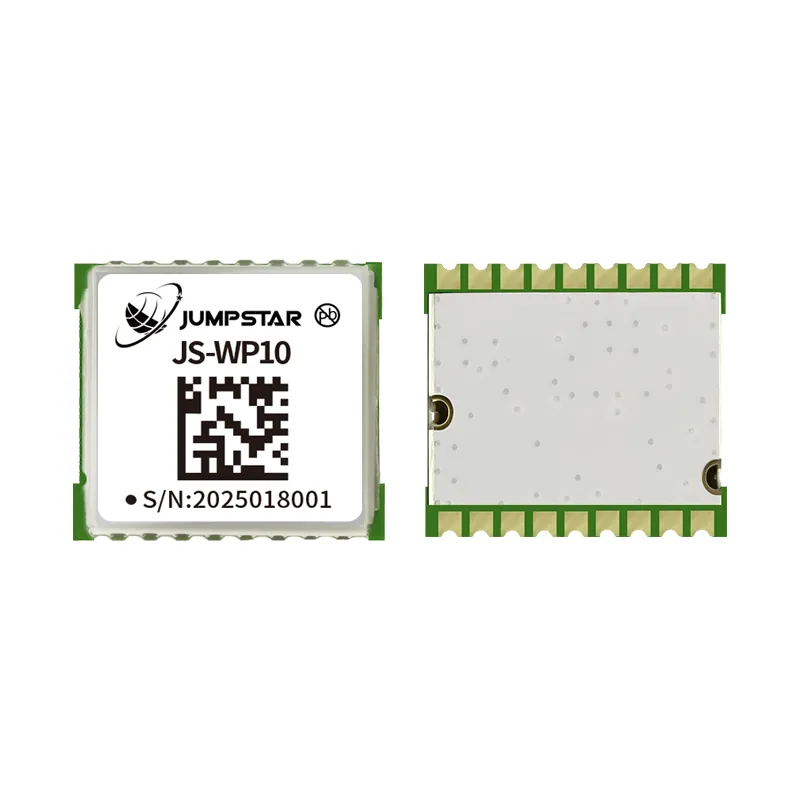
JS-WP10 Embedded GNSS Module
Standard-precision L1 GNSS module with 210 channels, 5 Hz update rate, and all-constellation concurrent reception. Compact 10.5 × 9.7 mm form factor designed for direct OEM integration into drones, IoT devices, and consumer electronics.
View Product Details →An engineer integrating the JS-WP10 only needs to provide an antenna, a stable 3.3V supply, and a UART connection to the host MCU. NMEA sentences arrive at the configured baud rate, and the host firmware parses latitude, longitude, altitude, and velocity. The integration effort is measured in days, not weeks. This simplicity makes embedded GNSS modules the default choice for applications that need reliable positioning without the complexity of high-precision correction processing.
What Is a GNSS Receiver Module?
A GNSS receiver module — particularly an RTK GNSS receiver module — represents a significant step up in hardware integration, signal processing capability, and positioning accuracy. While a basic GNSS module provides autonomous positioning in the 2–3 meter range, an RTK GNSS receiver module delivers centimeter-level accuracy by applying real-time kinematic corrections to carrier-phase measurements.
What Makes an RTK GNSS Receiver Module Different?
An RTK GNSS receiver module builds on the foundations of a standard GNSS module but adds several critical capabilities that enable high-precision positioning:
- Multi-frequency reception — instead of L1 only, these modules track L1/L2 (and sometimes L5) signals simultaneously. Dual-frequency operation enables the module to calculate and compensate for ionospheric delay, which is the single largest source of GNSS positioning error.
- Carrier-phase tracking — beyond pseudorange measurements (code phase), RTK modules track the carrier wave phase of GNSS signals. This provides far more precise range measurements, which are essential for centimeter-level positioning.
- RTCM correction processing — the module accepts RTCM-format correction data from a base station or NTRIP network and applies real-time differential corrections to resolve integer ambiguities in carrier-phase measurements.
- Base/Rover dual-mode operation — many RTK receiver modules can be configured as either a base station (transmitting corrections) or a rover (receiving and applying corrections), providing deployment flexibility.
- Higher channel counts — dedicated search and tracking channels handle the additional computational load of multi-frequency, multi-constellation signal processing.
Example: JUMPSTAR JS-UK39-F RTK GNSS Receiver Module
The JS-UK39-F demonstrates what a production-grade RTK GNSS receiver module delivers. It operates on both L1 and L2 frequencies across GPS, GLONASS, BeiDou, and Galileo constellations, with 192 search channels and 60 dedicated tracking channels. RTK positioning accuracy reaches 1 cm + 1 ppm horizontally, with an update rate of up to 25 Hz. Sensitivity extends to -167 dBm for tracking, enabling reliable performance in challenging environments where a standard module would lose lock.
.png?imageMogr2/format/webp)
JS-UK39-F RTK GNSS Receiver Module
Centimeter-level RTK positioning module with L1/L2 dual-frequency support, 192 search + 60 tracking channels, -167 dBm tracking sensitivity, 25 Hz update rate, and Base/Rover dual-mode operation. Designed for UAV navigation, precision agriculture, surveying, and autonomous systems.
View Product Details →Integrating the JS-UK39-F requires more design effort than a basic module. The engineer must handle the correction data stream (typically arriving via a separate communication link such as 4G or UHF radio), implement RTCM parsing and forwarding to the module, and manage the module's configuration for base or rover operation. The reward for this additional complexity is two orders of magnitude better positioning accuracy: centimeters instead of meters. For applications where positioning precision directly determines the product's value — autonomous machinery guidance, survey-grade measurement, precision UAV flight paths — this trade-off is not just justified; it is essential.
GNSS Module vs GNSS Receiver Module: Key Differences
The table below summarizes the critical engineering differences between a standard GNSS module and an RTK GNSS receiver module. Use this as a quick reference when evaluating hardware for a new design.
| Parameter | GNSS Module | RTK GNSS Receiver Module |
|---|---|---|
| Hardware Integration | Chipset + RF front-end on single board; host MCU handles application logic | Full GNSS engine with multi-band RF, RTK processing, and correction data handling onboard |
| Positioning Accuracy | 2–3 meters (autonomous) | 1 cm + 1 ppm (RTK fixed) |
| Frequency Support | L1 only (single-band) | L1/L2 dual-frequency; some support L5 |
| RTK Capability | Not available | Yes — RTCM correction input, carrier-phase tracking, ambiguity resolution |
| Correction Data | None required | RTCM from base station or NTRIP caster required for RTK operation |
| Channel Count | ~200 search + tracking combined | 192+ search channels plus 60+ dedicated tracking channels |
| Sensitivity | Typically -165 to -162 dBm tracking | -167 dBm tracking sensitivity; better signal acquisition in weak-signal environments |
| Update Rate | 1–10 Hz typical | Up to 25 Hz; supports high-dynamic applications |
| Base/Rover Mode | Not supported | Yes — configurable as base station or rover |
| Development Complexity | Low — antenna + power + UART; NMEA output ready to use | Medium to High — correction data handling, RTCM protocol, configuration management required |
| Power Consumption | 30–80 mW typical | 200–500 mW typical (additional processing and dual RF chains) |
| Typical Applications | Asset tracking, IoT sensors, consumer drones, wearable devices | Surveying equipment, autonomous vehicles, precision agriculture, UAV navigation, robotics |
| Cost | Low — minimal BOM cost and integration effort | Higher — reflects additional hardware, firmware, and performance |
Key Takeaway
If your application requires better than 1-meter accuracy, you are almost certainly looking at an RTK GNSS receiver module. A standard GNSS module physically cannot achieve this level of precision regardless of antenna quality or firmware optimization.
GNSS Module vs RTK GNSS Receiver Module: Hardware Architecture Differences
Understanding the architectural differences between these two solutions helps engineers plan their system design more effectively. The integration requirements differ significantly in both hardware and firmware.
Standard GNSS Module Architecture
A standard GNSS module implements a straightforward signal chain:
- Antenna input — passive or active antenna connected via U.FL or solder pad.
- SAW filter + LNA — bandpass filtering and low-noise amplification of GNSS L1 signals.
- RF front-end + baseband processor — signal down-conversion, acquisition, and tracking.
- Position computation — the onboard firmware calculates PVT (Position, Velocity, Time) from pseudorange measurements.
- Serial output — NMEA sentences or vendor-specific binary protocol output to the host MCU via UART/I²C/SPI.
From the host system's perspective, the GNSS module is essentially a peripheral. The host MCU reads the serial stream, extracts the fields it needs, and feeds the data into the application. There is no correction data to manage, no base station to configure, and no ambiguity resolution to monitor. The system architecture is simply:
GNSS Antenna → GNSS Module → Host MCU → Application
RTK GNSS Receiver Module Architecture
An RTK GNSS receiver module requires a more sophisticated system architecture. Beyond the standard GNSS signal chain, it adds several critical processing layers:
- Multi-band RF front-end — separate RF chains for L1 and L2 (and L5 where supported), each with dedicated filtering and amplification.
- Parallel signal processing — the baseband processor handles code-phase and carrier-phase tracking simultaneously across all active frequency bands and constellations.
- RTK engine — this is the key differentiator. The RTK engine applies correction data to carrier-phase measurements, resolves integer ambiguities, and produces the fixed RTK solution.
- Correction data interface — the module must receive RTCM correction data from an external source (base station, NTRIP caster, or radio link). This typically arrives through a separate communication channel.
- High-rate output — RTK-corrected position, velocity, and attitude data output at 10–25 Hz to support dynamic applications.
The system architecture for an RTK solution adds an external correction data path:
GNSS Antenna → RTK Receiver Module → Host MCU → Application
↑ Correction Data (RTCM via 4G/UHF/NTRIP)
This additional complexity has practical implications for the design team. The hardware engineer must add a correction data modem (4G module or UHF radio) to the BOM. The firmware engineer must implement RTCM message parsing and forwarding, handle NTRIP client connectivity, and manage the receiver's operating mode (base vs. rover) and configuration. The validation team must test RTK fix acquisition time, reacquisition performance, and accuracy under various baseline distances and environmental conditions.
When Should You Choose a GNSS Module?
A standard GNSS module is the right choice when your application requirements fall within these boundaries:
Positioning Accuracy of 2–3 Meters Is Sufficient
If your product needs to know which street a vehicle is on, which field a sensor node is deployed in, or the approximate location of a package, a standard GNSS module delivers more than enough precision. Applications like fleet telematics, asset trackers, and IoT environmental sensors operate well within this accuracy range.
Battery Life Is a Primary Concern
Embedded GNSS modules draw significantly less power than RTK receiver modules — typically one-fifth to one-tenth the current. For battery-powered devices that must operate for months or years between charges, the power savings of a standard module are decisive. The JS-WP10, for example, can enter low-power tracking modes that extend battery life considerably while maintaining periodic position updates.
PCB Space and BOM Cost Are Tightly Constrained
Standard GNSS modules with footprints under 12 mm × 12 mm integrate into even the most space-constrained designs. With a minimal external component count — typically just an antenna, decoupling capacitors, and a backup capacitor for the RTC — the total PCB area and BOM cost remain low.
Development Timeline Is Aggressive
Integrating a standard GNSS module is a well-understood process. Most modules output NMEA sentences by default, and reference designs, application notes, and community resources are widely available. An experienced embedded engineer can have a module producing reliable position fixes on a prototype PCB within a single workday.
Best Fit
Typical applications for standard GNSS modules include consumer drones with basic RTH (Return to Home) functionality, asset tracking tags, agricultural sensor nodes, wildlife tracking collars, and any IoT device where knowing position within a few meters satisfies the use case.
When Should You Choose an RTK GNSS Receiver Module?
An RTK GNSS receiver module becomes necessary when the application demands positioning accuracy that a standard module fundamentally cannot provide. These are the scenarios where RTK is the right call:
You Need Centimeter-Level Accuracy
Surveying equipment, construction machine control, and precision agriculture implement guidance all require positioning accuracy in the centimeter range. A deviation of even 10–20 centimeters renders these systems unusable for their intended purpose. The JS-UK39-F delivers 1 cm + 1 ppm RTK accuracy, which is the level of precision professional surveyors and machine control systems depend on.
Your Application Operates in Signal-Challenged Environments
Urban canyons, tree canopy, and near metallic structures create multipath and signal attenuation. RTK receiver modules with -167 dBm tracking sensitivity and multi-frequency support can maintain lock and produce reliable fixes in conditions where standard modules experience frequent dropouts. Dual-frequency operation also provides ionospheric correction that improves accuracy during periods of high solar activity.
The Product Needs to Function as Both Base and Rover
Some applications require the same hardware to operate as either a base station or a rover, depending on deployment. Survey teams, for example, may configure one unit as a temporary base station while others operate as rovers. Modules like the JS-UK39-F support dual-mode operation, eliminating the need to design and stock two separate hardware SKUs.
High-Dynamic Performance Is Required
UAVs flying at 15–20 m/s, autonomous ground vehicles navigating at speed, and robotic systems executing rapid maneuvers need position updates at rates significantly above 10 Hz. RTK receiver modules typically support 20–25 Hz output rates, providing the low-latency, high-accuracy position data that flight controllers and navigation systems demand for stable control loops.
Important
RTK GNSS receiver modules are not just "more accurate GNSS modules." They are fundamentally different hardware platforms built around a different signal processing architecture. The decision to use one should be driven by whether centimeter-level accuracy, multi-frequency processing, or RTK correction support is essential to the product's core function.
When Do You Need a Complete RTK Receiver Solution?
There is a third tier in the GNSS positioning hardware hierarchy beyond embedded modules: the complete RTK receiver solution. This is a fully integrated, enclosure-ready device that packages an RTK engine, multi-band RF, correction data modem, and external interfaces into a single unit. It sits at the top of the integration pyramid:
GNSS Module → RTK GNSS Receiver Module → Complete RTK Receiver Solution
Complete receiver solutions are the right choice for applications where maximum performance is required and the engineering effort of integrating and certifying a module-level solution does not make economic sense. They are particularly well-suited to:
- Autonomous UAV and drone navigation — where dual-antenna heading, anti-jamming, and anti-spoofing are mandatory for safe operation beyond visual line of sight.
- Robotics and autonomous ground vehicles — where ultra-low latency position and attitude data feed directly into real-time control algorithms.
- Professional surveying systems — where the receiver is the primary measurement instrument and must meet survey-grade accuracy standards out of the box.
- Rapid prototyping and low-volume production — where the NRE cost of module-level integration exceeds the per-unit premium of a complete receiver.
Example: JUMPSTAR X43H-AH Professional RTK Receiver
The X43H-AH illustrates what a complete RTK receiver solution brings to the table. It features 789 hardware channels for all-constellation, multi-frequency (L1/L2/L5) signal processing, dual-antenna heading capability, and RTK horizontal accuracy of 0.6 cm + 0.5 ppm. Designed for autonomous systems, it incorporates anti-jamming and anti-spoofing protection alongside ultra-low latency position output at up to 20 Hz.
.jpg?imageMogr2/format/webp)
X43H-AH Professional RTK Receiver Solution
Complete RTK positioning system with 789 hardware channels, L1/L2/L5 multi-frequency support, dual-antenna heading, 0.6 cm + 0.5 ppm RTK accuracy, anti-jamming and anti-spoofing protection, and ultra-low latency output. Built for UAV navigation, robotics, and autonomous system integration.
View Product Details →The decision between integrating a module versus deploying a complete receiver comes down to a trade-off between engineering investment and unit cost. Module integration requires more upfront design effort but yields lower per-unit BOM cost at volume. A complete receiver solution reduces time to market and eliminates integration risk, at a higher per-unit hardware cost. For many autonomous system developers, the reduced development timeline and validated performance of a complete solution make it the preferred path.
How to Choose the Right GNSS Solution
Selecting the right GNSS positioning hardware for your product requires working through four key decision points. Answering each one honestly against your product requirements will point you toward the correct solution tier.
1. Define Your Accuracy Requirements
This is the most important filter. If your product can function with 2–3 meter accuracy, a standard GNSS module is almost certainly the right choice — it will be smaller, cheaper, and simpler to integrate. If you need sub-meter accuracy for lane-level navigation or precision guidance, you need at minimum a DGNSS or SBAS-capable receiver. If you need centimeter-level accuracy for survey, machine control, or autonomous operation, RTK is non-negotiable.
- Standard positioning (2–3 m) → GNSS Module
- Sub-meter positioning → GNSS Receiver Module with SBAS/DGNSS
- Centimeter-level RTK positioning → RTK GNSS Receiver Module or Complete RTK Receiver
2. Consider Integration Requirements
How much design and development resource do you have available for GNSS integration? A module-level approach requires hardware design, firmware development, and validation. A complete receiver solution reduces the integration to mechanical mounting, power wiring, and data interface configuration. Be realistic about your team's bandwidth and expertise.
3. Evaluate the Application Environment
The operating environment affects both the required sensitivity and the need for multi-frequency support. Applications operating under open sky with good satellite visibility can achieve their accuracy targets with simpler hardware. Applications in urban environments, under tree canopy, or near reflective surfaces need better sensitivity, multi-frequency ionospheric correction, and possibly anti-jamming features.
- Open sky, stationary or low dynamics → standard GNSS module may be sufficient.
- Urban canyons, partial obstruction → multi-constellation, higher sensitivity receiver module recommended.
- Industrial, high-interference environments → RTK receiver with anti-jamming and anti-spoofing protection.
4. Consider Development Resources and Timeline
Integrating a GNSS module typically requires 2–4 weeks of engineering effort for a competent embedded team, plus antenna tuning and validation. An RTK GNSS receiver module adds correction data management, NTRIP client implementation, and RTK performance validation — expect 6–12 weeks for a production-ready design. A complete RTK receiver solution can be integrated in days, making it the fastest path to market.
JUMPSTAR GNSS Positioning Solutions
JUMPSTAR provides GNSS positioning hardware across all three tiers of the integration pyramid, allowing OEM customers to select the solution level that matches their application requirements and development resources:
- Embedded GNSS Modules — compact, low-power positioning components for direct OEM integration. Suitable for IoT devices, consumer drones, asset trackers, and any application where standard accuracy and minimal BOM impact are the priorities.
- RTK GNSS Receiver Modules — multi-frequency, centimeter-level positioning modules with RTK correction support, base/rover dual-mode operation, and 25 Hz output. Built for surveying equipment, precision agriculture, UAV navigation, and autonomous systems.
- Professional RTK Receiver Solutions — complete, enclosure-ready positioning systems with 789 channels, dual-antenna heading, anti-jamming and anti-spoofing protection, and ultra-low latency output. Ideal for autonomous UAVs, robotics, and professional surveying applications.
The key to selecting the right solution is understanding where your application fits on the accuracy-vs-integration spectrum. Browse the full product range or contact the JUMPSTAR engineering team to discuss your specific requirements.
Frequently Asked Questions
What is the difference between a GNSS module and a GNSS receiver module?
A GNSS module is a basic embedded positioning component that provides autonomous positioning with 2–3 meter accuracy using single-band (L1) reception. A GNSS receiver module, particularly an RTK GNSS receiver module, adds multi-frequency support, carrier-phase tracking, RTCM correction processing, and base/rover dual-mode operation, enabling centimeter-level positioning accuracy. The receiver module includes significantly more signal processing capability and requires external correction data for RTK operation.
Is an RTK GNSS receiver module more accurate than a standard GNSS module?
Yes, by approximately two orders of magnitude. A standard GNSS module typically achieves 2–3 meters of autonomous accuracy. An RTK GNSS receiver module achieves 1 cm + 1 ppm under RTK fixed conditions. This accuracy improvement comes from dual-frequency carrier-phase tracking and real-time differential correction processing — capabilities that standard GNSS modules do not possess.
Do GNSS modules need an external processor?
Yes. GNSS modules output position data (typically in NMEA format) over a serial interface, but they require a host microcontroller to parse the data, manage the module's configuration, and integrate positioning information into the application. The host MCU handles power management, communication protocols, and any application-specific processing.
Which GNSS solution is better for UAV applications?
It depends on the UAV's mission profile. Consumer and hobby drones performing basic Return-to-Home functions can use a standard GNSS module. Professional UAVs conducting precision surveying, autonomous inspection, or agricultural spraying require an RTK GNSS receiver module for centimeter-level accuracy. Autonomous UAVs operating beyond visual line of sight may need a complete RTK receiver solution with dual-antenna heading and anti-jamming protection for safety-critical navigation.
When should I choose RTK positioning over standard GNSS?
Choose RTK when your application's core function depends on positioning accuracy better than 1 meter. This includes surveying and mapping, precision agriculture (auto-steer and section control), construction machine guidance, autonomous vehicle navigation, and any application where a positioning error of even a few tens of centimeters would compromise the product's performance or safety.
Can GNSS receiver modules be integrated into OEM products?
Absolutely. RTK GNSS receiver modules are specifically designed for OEM integration. They are typically supplied as board-level products that can be mounted inside the host system enclosure, connected to the host MCU via standard serial interfaces. The main additional design considerations compared to a basic module are the correction data communication link and the increased power and PCB area requirements.
What is the difference between a GNSS module and an OEM board?
The terms are sometimes used interchangeably, but GNSS modules are generally smaller, lower-cost embedded components with basic positioning capability and minimal external interfaces. OEM boards are larger, more capable RTK receivers with richer I/O, higher update rates, and survey-grade firmware. An OEM board is closer to a complete receiver solution than to a basic GNSS module, and it typically requires less host-side processing than a module-level integration.
Do I need a base station for RTK to work?
Yes, RTK positioning requires a source of correction data. This can be a physical base station you set up at a known location, a network RTK service (NTRIP) accessed via the internet, or a local CORS (Continuously Operating Reference Station) network. The correction data is transmitted in RTCM format and must be forwarded to the RTK GNSS receiver module through a communication link such as 4G cellular, UHF radio, or Wi-Fi.
Related Resources:
• JUMPSTAR GNSS Products — Browse the full product portfolio
• Contact JUMPSTAR — Discuss your project with an application engineer
• JS-WP10 Datasheet — Standard precision GNSS module
• JS-UK39-F Datasheet — RTK GNSS receiver module
• X43H-AH Datasheet — Professional RTK receiver solution
.png?imageMogr2/format/webp)
.png?imageMogr2/format/webp)