





Every GNSS receiver, no matter how advanced, is only as good as the signal that reaches it. A high gain GNSS antenna is often the difference between a receiver that tracks satellites reliably and one that struggles with weak signals, long cable runs, or obstructed views of the sky. Yet "high gain" is also one of the most misunderstood specifications in GNSS, because it can refer to two very different things: the gain of the antenna element itself, measured in dBi, and the gain of the low-noise amplifier built into an active antenna, measured in dB.
This article explains what high gain means in a GNSS antenna, how antenna element gain and LNA gain differ, when a high gain GNSS antenna genuinely helps, and how to read a specification sheet without being misled by a single headline number. If you are selecting an antenna for surveying, UAVs, timing, marine, or industrial positioning, this guidance will help you match the antenna to the RF conditions your application actually faces.
What Does "High Gain" Mean in a GNSS Antenna?
In radio terms, gain is the ability of an antenna to concentrate energy in certain directions. A GNSS antenna receives signals from satellites spread across the sky, so its design must balance gain against coverage. A high-gain element collects more of the weak satellite signal and delivers a stronger output for the receiver to process, which directly improves the signal-to-noise ratio at the receiver front end.
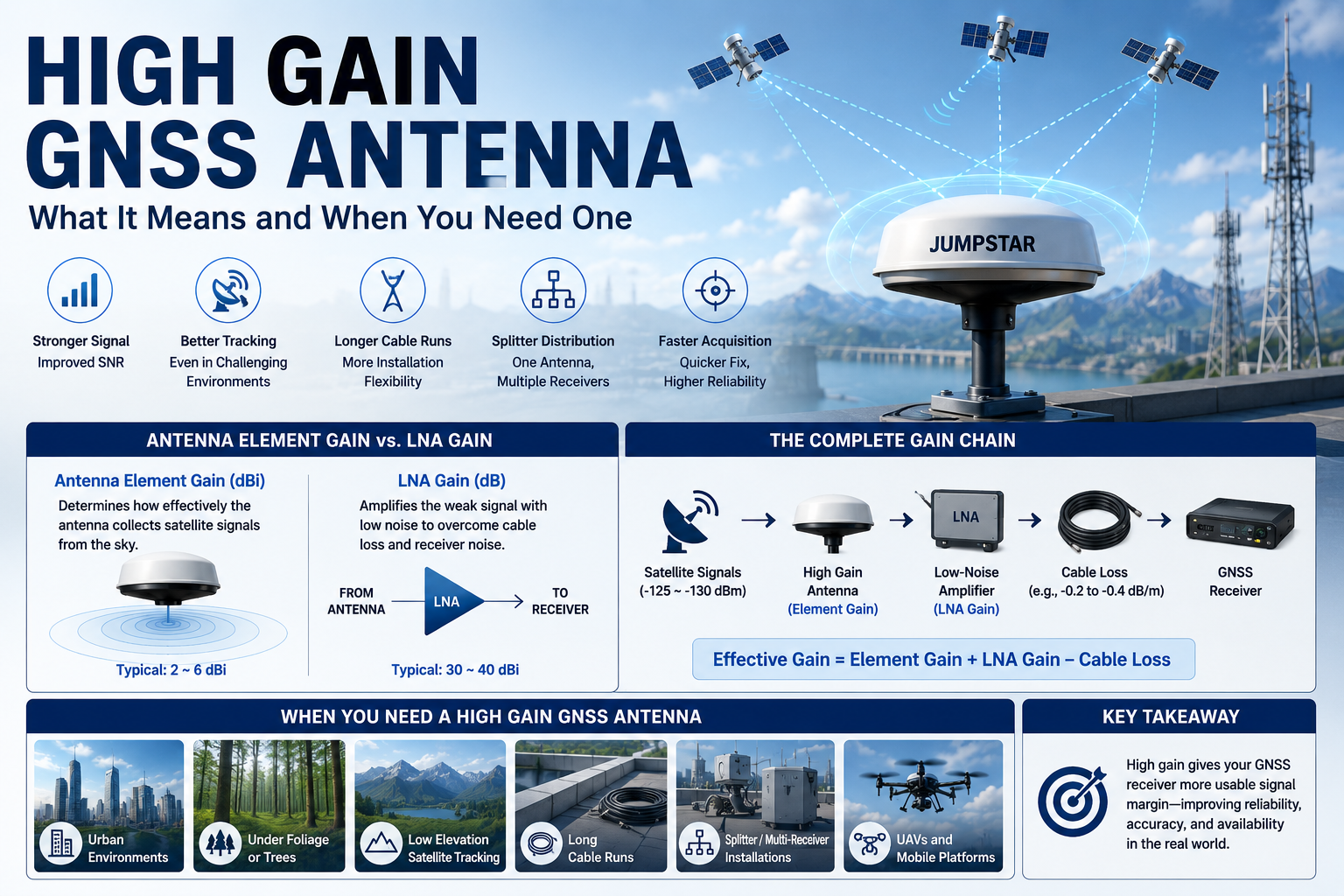
There is an important distinction to keep in mind. A passive GNSS antenna element has gain measured in dBi — decibels relative to an isotropic radiator — and typical values run from a few dBi up to roughly five or six dBi for survey-grade elements. An active GNSS antenna adds a low-noise amplifier, whose gain is measured in dB and is often in the range of 30 to 40 dB. When a data sheet says "high gain," it may be referring to either figure, or to the complete chain. Understanding which one is meant is the first step to making the right choice.
Antenna Element Gain vs. LNA Gain: Why Both Matter
The antenna element and the LNA do different jobs, and neither replaces the other. The element collects satellite energy from the sky and determines the antenna's directional pattern, phase center stability, and multipath behavior. The LNA amplifies the tiny signal at the feed point so that downstream cable loss and receiver noise do not dominate the measurement.
A high-gain element captures more signal where it matters for the application — for example, maintaining good reception of low-elevation satellites, which improves the geometry of the position solution. A well-designed LNA then amplifies that captured signal with minimal added noise. Element gain defines how efficiently the antenna collects energy; LNA gain defines how much headroom the signal has after amplification and before it is attenuated by the cable.
Both figures matter, but a single number on a data sheet can be misleading. A high-gain element paired with a poor LNA, or a strong LNA attached to a badly designed element, both deliver disappointing real performance. The figure worth comparing across antennas is the complete chain: element gain plus LNA gain minus cable loss, delivered to the receiver with the lowest practical noise figure.
How High Gain Improves GNSS Reception
GNSS satellite signals arrive at the Earth's surface at very low power levels — typically between about −125 dBm and −130 dBm for a receiver under an open sky, and lower still when the signal is partially blocked by terrain or structures. A high gain GNSS antenna raises the signal level before it reaches the receiver, which improves the carrier-to-noise ratio and gives the tracking loops a stronger signal to lock onto.
In practice, higher effective gain translates into a predictable set of benefits:
- More reliable weak-signal reception — in environments with partial obstruction, such as urban canyons, under foliage, or near building edges, the extra signal margin keeps satellites trackable.
- Better low-elevation tracking — satellites close to the horizon are harder to receive, and they contribute directly to position geometry; a high-gain antenna holds them longer.
- Longer cable runs — every meter of coaxial cable attenuates the signal, and higher gain gives you headroom to place the antenna where the sky is clearest rather than where the receiver happens to be mounted.
- Splitter distribution — in timing and fixed-infrastructure applications, one antenna can feed several receivers when the gain budget is sufficient.
- Faster acquisition — a stronger signal at the front end reduces time-to-first-fix after a cold start or signal outage.
One point deserves emphasis: gain does not create signal where none exists. No antenna can recover a satellite that is completely blocked by solid terrain. What a high-gain antenna does is preserve and amplify the usable signal so that the receiver gets the best possible input, which is exactly what marginal RF environments require.
The Real Benefits of a High Gain GNSS Antenna
The value of high gain is best understood through the situations where it makes the largest difference. In surveying and RTK work, a high-gain survey antenna with a stable phase center maintains millimeter-level measurement quality even when satellites are low on the horizon. In UAV applications, a lightweight high-gain active antenna keeps positioning stable while the platform moves and banks, and its elevated signal level helps the receiver ride through brief obstructions.
In timing and synchronization systems, antennas are often mounted on rooftops or towers while the receivers sit in equipment rooms, with cables that run tens of meters. High gain is what makes that layout work: it compensates for the cable attenuation so the receiver sees a usable signal. In marine and industrial settings, rugged high-gain antennas deliver the same benefit in environments where the antenna cannot be placed close to the electronics.
When Gain Alone Is Not Enough
Many buyers chase the highest gain number, but in GNSS the quality of the signal matters more than raw gain. A specification sheet can make one antenna look superior on gain while a different antenna performs better in the field, because several other parameters shape real-world results.
- Noise figure — the LNA must add as little noise as possible. A high-gain amplifier with a high noise figure can be worse than a lower-gain amplifier with excellent noise performance, because the noise figure determines the weakest signal the chain can still process.
- Phase center stability — for RTK and survey-grade measurement, the electrical phase center must stay stable across frequency and elevation. Gain cannot compensate for a wandering phase center.
- Multipath rejection — reflected signals from buildings and metal structures create errors that amplification does not fix. Antenna design, ground planes, and chokes handle multipath, and no amount of gain removes it.
- Frequency and constellation coverage — a high-gain antenna that covers only L1 is less valuable for multi-frequency RTK than a slightly lower-gain antenna covering L1, L2, and L5. For background on why the bands matter, see our article on multi-constellation GNSS and the L1, L2, and L5 frequency bands.
The practical conclusion is simple: evaluate gain together with noise figure, phase center, frequency coverage, and mechanical fit. The right high gain GNSS antenna is the one that delivers the best signal quality for your specific application, not necessarily the one with the biggest number on the box.
High Gain GNSS Antenna Applications
High-gain GNSS antennas earn their keep across a wide range of industrial and professional applications:
Surveying and RTK
Survey crews need reliable satellite tracking at low elevation angles and a phase center stable enough for centimeter-level measurement. High-gain RTK antennas with wide beams hold satellites longer and reduce the time spent waiting for a fixed solution.
UAVs and Drones
UAV platforms demand antennas that are light, compact, and still powerful enough to hold signals while the platform maneuvers. Active high-gain antennas with low noise figures keep positioning stable during flight, which matters for mapping, inspection, and autonomous operations.
Timing and Synchronization
Network timing, power-grid synchronization, and financial infrastructure rely on GNSS timing receivers that often sit far from their antennas. High gain plus splitter capability makes these long-cable installations practical and reliable.
Marine and Industrial
On vessels and in industrial yards, antennas must survive harsh conditions while delivering dependable signal levels to receivers mounted inside cabins or control rooms. Rugged, waterproof high-gain antennas fill this role with minimal maintenance.
Precision Agriculture and Infrastructure Monitoring
Agricultural machinery and structural monitoring systems operate for long hours in open or partially obstructed environments. Consistent, high-quality signal reception reduces positioning dropouts and keeps measurement records continuous.
How to Choose a High Gain GNSS Antenna
Selection starts with the application and the RF environment, not with a single gain figure. Work through these questions in order:
- Passive or active? — if the cable is short and the receiver provides bias voltage for an LNA, an active antenna is usually the right call. If the receiver has no LNA bias, you need a passive element and must manage cable loss carefully.
- Which frequency bands? — confirm that the antenna covers the bands your receiver uses, especially for multi-frequency RTK (L1, L2, and L5 where applicable).
- What is the noise figure? — look for the lowest practical LNA noise figure; it matters more than a few extra dB of gain in weak-signal performance.
- Is the phase center stable? — for RTK and survey work, check the documented phase center error and its variation across frequency and elevation.
- Does the mechanical design fit? — size, weight, mounting, connector, and IP rating must match your platform and environment.
- How long is the cable? — include cable attenuation in the gain budget so the receiver sees an adequate signal at the connector.
A useful way to compare antennas is to compute the effective gain the receiver actually sees: element gain plus LNA gain minus cable and connector loss. All else being equal, the antenna with the highest effective gain and the lowest noise figure will deliver the strongest, cleanest signal.
JUMPSTAR High Gain GNSS Antennas
JUMPSTAR offers high-gain GNSS antennas across different form factors, so OEMs can match antenna performance to the constraints of the platform. Three examples illustrate the range:
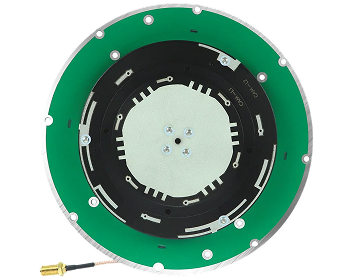
The JS-YAC130N is a built-in high-precision survey antenna that combines GNSS positioning with 4G communication and 2.4 GHz Bluetooth in a single compact unit. It covers the full GNSS constellations on L1 and L2, delivers a GNSS peak gain of 5.5 dB or higher with a stable phase center, and runs from a wide 3.3 to 12 V input at low current. With an ultra-compact Ø130 × 15 mm profile and an operating range of −40 °C to +85 °C, it suits surveying equipment, monitoring stations, and embedded receiver designs.
For RTK surveying and deformation monitoring, the JS-HAC148A is a quad-system, full-frequency antenna with a phase center error of 2 mm or less, which is essential for millimeter-level measurement. Its high-gain, wide-beam design maintains strong low-elevation signal reception in obstructed environments, while the IPX6 waterproof enclosure and magnetic mount make field deployment fast and dependable across a −40 °C to +85 °C range.
Where weight and size are tight, the JS-HAC42A-F is a helical active antenna covering all GNSS constellations and frequency bands in a lightweight 27.3 g package. It combines 37 ± 3 dB of LNA gain with a 2 dB noise figure, offers 360° coverage with high gain at low elevation angles, and is IP65 waterproof for outdoor use — a natural fit for UAV and handheld positioning devices. The complete range of modules, receivers, and antennas is available on the JUMPSTAR products page.
The right choice depends on your frequency requirements, mechanical constraints, and the RF environment the antenna will operate in. JUMPSTAR's antenna portfolio is designed so that OEMs can select the combination that fits their platform without compromising signal quality.
Pairing a High Gain Antenna with the Right Receiver
An antenna is only one part of the signal chain. The receiver's front-end sensitivity, tracking capabilities, and interference handling determine what it can do with the signal the antenna delivers. A high gain GNSS antenna feeds the receiver a stronger, cleaner signal, but the receiver must be able to use it — supporting the right constellations and frequency bands, maintaining lock under dynamic motion, and rejecting interference when it appears.
The most reliable systems are designed as a whole: the antenna selected for the RF environment, the cable and connectors chosen to minimize loss, the receiver matched to the required accuracy and update rate, and the placement planned so the antenna sees the clearest view of the sky. When these pieces work together, the gain on the specification sheet turns into positioning performance in the field.
Conclusion
A high gain GNSS antenna is a practical tool for improving weak-signal reception, extending cable distances, and maintaining reliable tracking in difficult RF environments — but only when the gain is part of a well-designed chain. Element gain, LNA gain, noise figure, phase center stability, frequency coverage, and mechanical fit all contribute to real-world positioning quality, and no single number tells the whole story.
JUMPSTAR combines high-gain GNSS antennas with high-precision receivers and OEM-oriented integration support, so you can build positioning systems that perform where it counts. If you are selecting an antenna for a new platform or upgrading an existing one, start with a conversation about your frequency requirements, cable layout, and operating environment.
Need a high gain GNSS antenna for your application?
JUMPSTAR provides high-gain GNSS antennas, modules, and receivers designed for OEM integration across surveying, UAV, timing, marine, and industrial applications.
Contact JUMPSTAR to Discuss Your Antenna Requirements.png?imageMogr2/format/webp)
.png?imageMogr2/format/webp)