





GNSS applications are moving into increasingly demanding environments: autonomous robots, UAVs flying near power infrastructure, smart transportation in urban areas, surveying around metal structures, and precision agriculture machinery in open fields. Satellite signals arrive at the Earth's surface at extremely low power levels — far weaker than most other radio signals nearby — which makes the receiver vulnerable to unwanted RF signals and to signals reflected off buildings, vehicles, and metal structures.
For this reason, high positioning accuracy alone is no longer enough. A receiver may look excellent on paper, but if it cannot hold a stable fix when the RF environment turns hostile, the application fails. Reliability under interference matters as much as accuracy, and this is where anti-jamming GNSS technology comes in. This article explains what GNSS interference is, how it degrades positioning, how anti-jamming techniques work, and what OEMs should evaluate when selecting an anti-jamming GNSS receiver or module.
What Is GNSS Interference?
A GNSS receiver must detect and process extremely weak satellite signals — typically around −125 dBm or lower at the antenna. When other RF signals enter the receiver front end, they can overwhelm this tiny signal: reducing signal-to-noise conditions, interrupting satellite lock, increasing positioning errors, slowing RTK convergence, and in severe cases causing a complete loss of positioning availability.
The key idea is simple. The problem is not that the satellites disappear from the sky; the receiver may simply be unable to separate useful GNSS signals from unwanted RF energy arriving at the same antenna. When that separation fails, measurements degrade and the position output degrades with them. GNSS interference mitigation keeps measurements usable even when unwanted RF energy is present.
Where Does GNSS Interference Come From?
Interference sources fall into three broad categories, and a real deployment may face several of them at once.
Intentional Interference
Intentional interference includes jamming and other forms of deliberate RF interference designed to disrupt GNSS reception — for example, transmitting RF energy in or near GNSS frequency bands to make satellite tracking difficult or impossible. It is a security and resilience concern for critical infrastructure and any system whose operation depends on continuous positioning.
Unintentional Interference
Most interference in industrial environments is unintentional. Industrial electronics, power electronics, motors, communication equipment, and poorly shielded electronics can emit energy that falls inside GNSS bands or radiate broadband noise the receiver front end cannot fully filter. These sources are often close to the antenna, which makes them especially damaging.
Platform-Level Interference
A third source is the platform itself. Robots, UAVs, and vehicles carry switching power supplies, motors, digital electronics, and communication modules that can radiate interference toward the GNSS antenna mounted on the same platform. Antenna placement, grounding, shielding, and front-end filtering all determine how much of that noise reaches the receiver.
How GNSS Interference Affects Positioning Performance
The effects of interference on a positioning system form a cascade. Depending on severity, an OEM may see any of the following:
- Loss of satellite tracking — the receiver drops lock on individual satellites, reducing the geometry available for a position solution.
- Reduced positioning availability — the system may stop outputting a position, or switch to a lower-accuracy mode, for minutes or longer.
- RTK convergence problems — interference makes carrier-phase measurements noisier, so RTK initialization and fixing become slower and less stable.
- Increased positioning errors — even when a fix is maintained, degraded measurements can produce positions that jump, drift, or fall outside the expected error budget.
- Navigation instability — on UAVs, robots, and autonomous vehicles, an unstable position feed propagates directly into the navigation and control loops that steer the platform.
Positioning reliability is a system-level requirement, not just an accuracy specification. A receiver that meets its accuracy target on an open-sky test range can still fail in the field if it cannot handle the RF conditions of the real environment.
Anti-Jamming GNSS Technology: How Does It Work?
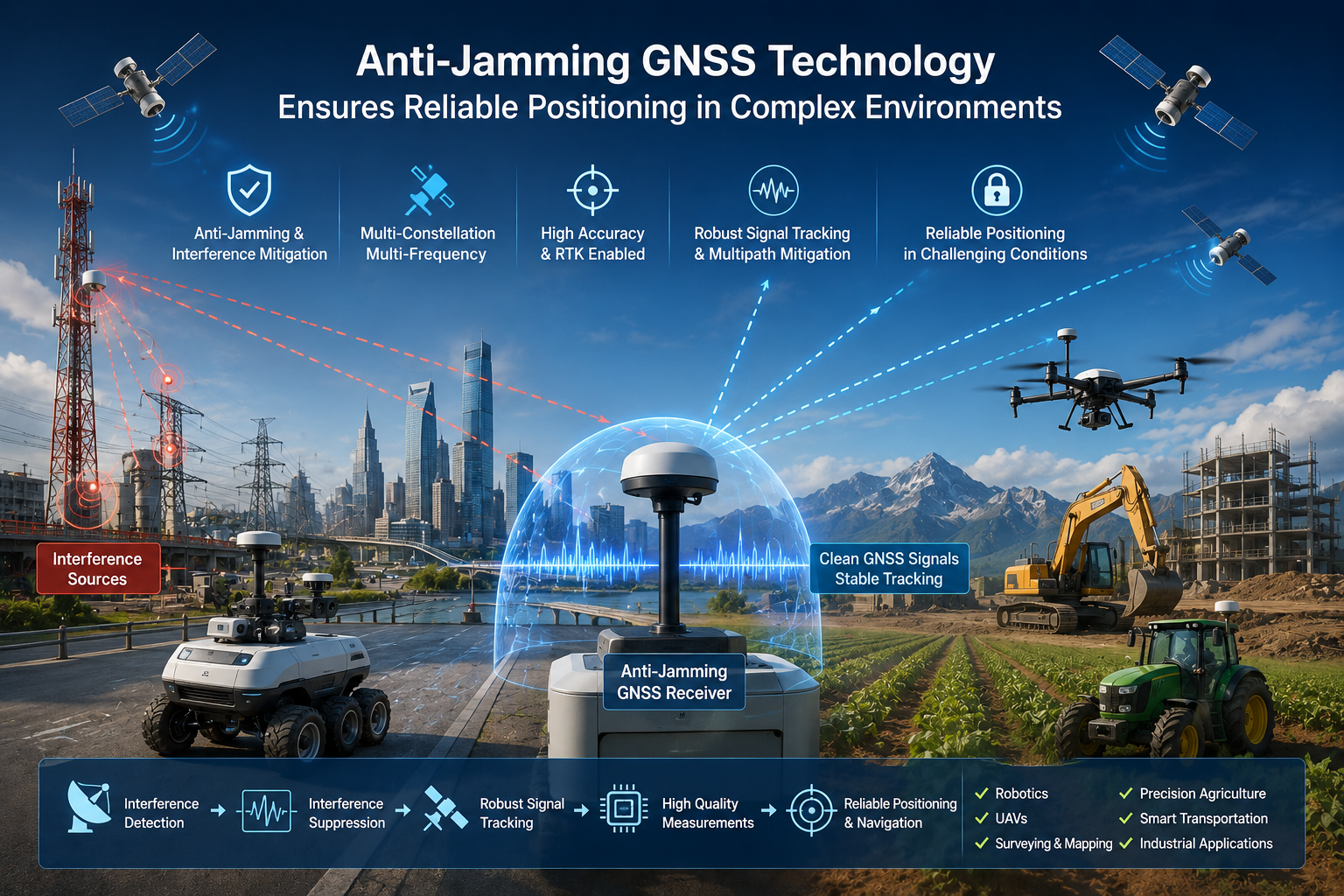
Anti-jamming GNSS technology is not a single feature but a set of techniques spanning the receiver's RF front end, signal processing, and positioning engine. Robust anti-jamming receivers combine several layers:
- Interference detection — the receiver continuously monitors the RF environment, identifying abnormal RF energy or sudden changes in signal conditions that indicate interference is present.
- Interference suppression — once interference is identified, suppression techniques reduce its impact on signal processing, for example by rejecting narrowband or single-tone interference inside the GNSS frequency bands.
- Robust signal tracking — tracking loops are designed to hold satellite signals as long as possible in degraded conditions, maintaining lock where a conventional receiver would give up.
- Multi-constellation reception — by processing GPS, BDS, GLONASS, Galileo, QZSS, and other constellations simultaneously (depending on the product), the system has more usable signals and more redundancy when some are affected.
- Multi-frequency reception — tracking L1, L2, and L5 adds diversity: interference rarely affects every band equally, so multi-frequency reception gives the positioning engine alternatives to work with.
It is important to be precise about what these techniques can and cannot do. Multi-constellation and multi-frequency reception dramatically improve robustness, but they do not completely eliminate interference — a powerful jammer can still overwhelm any receiver. The goal of anti-jamming technology is to extend the range of conditions in which the system keeps producing usable positioning, which is exactly what industrial applications need. For background, see our article on multi-constellation GNSS and the L1, L2, and L5 frequency bands.
Anti-Jamming Is Not the Same as Multipath Mitigation
Interference, multipath, and ionospheric effects are often discussed together, but they are different problems with different remedies.
- Interference refers to unwanted RF energy that degrades GNSS signal reception and processing — for example, a jammer or an industrial transmitter near the antenna.
- Multipath occurs when GNSS signals reflect off buildings, metal structures, or vehicles and reach the antenna both directly and via reflection paths. The reflected signals overlap the direct signal and introduce measurement errors that filtering alone cannot correct.
- Ionospheric effects are caused by changes in the ionosphere that affect GNSS signal propagation, particularly in certain conditions and regions. They alter signal delay in ways that must be modeled or corrected.
These problems can occur at the same time, which is why a high-reliability GNSS system addresses several fronts at once: interference mitigation, multipath mitigation, ionospheric mitigation, signal integrity, and multi-frequency reception. A receiver that handles interference well may still struggle with multipath in an urban canyon, and vice versa. For more, see our guide to multipath mitigation and advanced algorithms for urban positioning.
Why Anti-Jamming Matters for High-Precision RTK
RTK raises the bar on receiver performance. An RTK solution does not just produce a position; it needs stable carrier-phase tracking, reliable correction processing, fast and stable convergence, and continuous fixed solutions — all of which are vulnerable to interference:
Interference adds noise to carrier-phase measurements, making it harder to resolve integer ambiguities and hold a fixed solution. The result is slower initialization, more frequent loss of fix, and longer periods of degraded accuracy. In surveying, UAV mapping, agricultural machinery, autonomous robots, and power inspection, an RTK system that drops out of fixed mode in a noisy environment can be as disruptive as one that never reaches centimeter accuracy at all.
This is why anti-jamming capability can matter as much as the theoretical accuracy figure. A receiver that loses its fix every time a motor controller switches or a nearby transmitter goes active is less useful in practice than one that keeps a continuous fixed solution through the same conditions. GNSS interference suppression and stable RTK performance go hand in hand.
GNSS Anti-Jamming for Different Industrial Applications
How anti-jamming matters varies by application:
UAVs and Drones
UAV platforms are small, fast, and electrically noisy. Integration must be lightweight, positioning must stay stable during dynamic movement, and the RF environment — the UAV's own electronics, video links, and control links — can be crowded. Low latency and a high update rate matter as much as interference rejection.
Autonomous Robots
Outdoor robots need route following and repeatable positioning over long operating hours. Their own motors, power supplies, and communication modules create platform-level interference, while buildings and metal fixtures add multipath. Continuous positioning matters because a gap in the position feed interrupts the robot's task.
Precision Agriculture
Agricultural equipment navigates open fields with repeatable routes, machinery guidance, and autonomous implements. Interference sources are fewer than in urban areas, but reliability over large fields and long operating days is essential — a fix that drops during a pass means a missed or overlapped row.
Power and Infrastructure Inspection
Inspection platforms work close to electrical equipment, substations, and metal structures, where the RF environment is complex and unpredictable. Reliable positioning near infrastructure demands receivers that tolerate interference and keep tracking signals in the presence of strong nearby energy.
Surveying and Mapping
Survey crews demand centimeter-level accuracy and dependable RTK fixing. Signal availability and multipath around structures determine how reliably a base-rover pair reaches a fixed solution, and interference can stall production entirely.
What Should OEMs Look for in an Anti-Jamming GNSS Receiver?
When evaluating an anti-jamming GNSS receiver or module, read the specification sheet against the actual mission profile. The criteria that matter most:
- Interference detection and suppression — does the product implement dedicated detection and suppression techniques, as described in its official specifications?
- Multi-constellation support — check which constellations are actually supported (GPS, BDS, GLONASS, Galileo, QZSS, and others); more constellations mean more redundancy when some signals are degraded.
- Multi-frequency support — L1, L2, and L5 coverage adds diversity against interference and improves RTK robustness; confirm the bands from the data sheet.
- RTK performance — evaluate RTK accuracy, initialization speed, correction protocol support, and the stability of the fixed solution under degraded conditions.
- Update rate and latency — dynamic platforms need fresh position data at high rates with low latency; verify the receiver's actual figures.
- Multipath mitigation — for urban, industrial, and metal-rich environments, reflected-signal rejection is a distinct capability worth confirming.
- Anti-spoofing — where the product explicitly supports it, anti-spoofing protects against falsified GNSS signals. It is a different function from anti-jamming, so evaluate both against the product's actual capabilities.
- Size and power — for UAVs, robots, and embedded equipment, dimensions, weight, and power consumption are first-order constraints.
- Interfaces — match the documented electrical interfaces (UART, USB, Ethernet, CAN, I2C) to the host controller's buses.
No single product fits every platform, so selection should start from the operating environment rather than a headline accuracy number.
JUMPSTAR's Approach to Reliable GNSS Positioning
JUMPSTAR builds high-precision GNSS modules, receivers, and positioning solutions for OEM integration, focused on the conditions industrial platforms actually face. Its approach combines multi-constellation and multi-frequency reception, interference and multipath mitigation, ionospheric mitigation, high update rates with low latency, RTK capability, dual-antenna heading, and anti-spoofing support where a product provides it.
Reliable positioning comes from a combination of receiver architecture, signal processing, RF design, antenna selection, correction data, and system integration — not any single specification. The range is designed so OEMs can select the combination that fits their platform, from compact embedded modules to full-featured receivers.
JUMPSTAR GNSS Products with Anti-Jamming Capabilities
Three JUMPSTAR products illustrate how anti-jamming capability is implemented across different form factors:
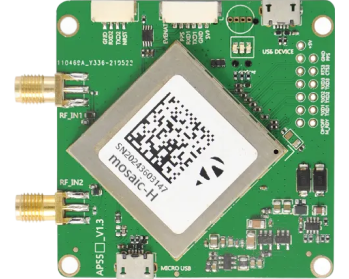
The JS-AP55 is a multi-band, multi-constellation GNSS receiver for UAV, robot, and autonomous driving applications. It combines 448 hardware channels with full-constellation reception (GPS, BDS, GLONASS, Galileo, QZSS, NavIC, and SBAS), a 100 Hz update rate with latency below 10 ms, and AIM+, IONO+, APME+, and RAIM+ technologies for robust performance in complex environments. RTK accuracy reaches 0.6 cm + 1 ppm, and the optional AP55H dual-antenna version adds heading down to 0.15°. OSNMA anti-spoofing support gives OEMs protection against both interference and falsified signals.
For platforms that need heading as well as positioning, the JS-CK15-3 is a multi-constellation receiver with dual-antenna heading and a built-in IMU. It delivers RTK accuracy of 8 mm + 1 ppm horizontal and 15 mm + 1 ppm vertical, up to 50 Hz positioning, and 100 Hz IMU output. Its anti-interference design suppresses narrowband and single-tone interference by up to 60 dB, and inertial navigation keeps positioning available when satellite signals are weak — well suited to UAV and robot platforms near electrical noise.
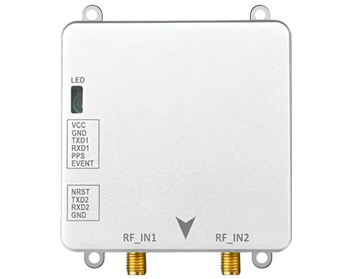
Where size and weight are tight, the JS-BCK43H-3 is a miniature multi-constellation, multi-frequency RTK module measuring 39.0 × 30.0 × 6.04 mm and weighing under 25 g. It pairs dual-antenna interferometry heading (0.2° at a 1 m baseline) with a built-in IMU, achieves RTK accuracy of 8 mm + 1 ppm with fast initialization, and suppresses narrowband and single-tone interference up to a 60 dB signal-to-interference ratio. Dual UART, Type-C, dual RF, PPS, and EVENT interfaces make it straightforward to embed.
The complete range of modules, receivers, and antennas is available on the JUMPSTAR products page.
Building a Reliable GNSS Positioning System
An anti-jamming receiver is only one part of a reliable GNSS positioning system. The full chain includes the GNSS receiver or module, the antenna, RF layout and cabling, antenna placement, the RTK correction source, the robot or vehicle controller, sensor fusion, and the software that ties it together.
Each link matters. A technically capable receiver can still perform poorly if the antenna is badly positioned, if the RF environment is ignored during system design, or if platform electronics radiate noise into the antenna's vicinity. The most reliable systems are engineered as a whole: antenna placement planned from the start, RF layout kept clean, and the receiver selected for the interference conditions it will actually meet.
Conclusion
In complex environments, high-precision GNSS cannot be judged by accuracy alone. The number on the specification sheet — 0.6 cm, 1 cm, or 2 cm — says little about how a receiver behaves when interference appears. What matters is signal availability, interference resistance, multipath mitigation, RTK stability, update rate, latency, and system integration. Anti-jamming GNSS technology addresses the most disruptive of these factors: it keeps the positioning engine working when unwanted RF energy is present, so the application keeps working too.
JUMPSTAR combines high-precision GNSS positioning technologies with interference mitigation and OEM-oriented integration options for demanding industrial applications. If you are building a platform that must hold reliable positioning in a challenging RF environment, start with a conversation about your operating conditions, constraints, and accuracy requirements.
Need reliable GNSS positioning in a complex RF environment?
JUMPSTAR provides anti-jamming GNSS modules, RTK receivers, and positioning solutions designed for OEM integration across UAVs, robots, agriculture, surveying, and industrial applications.
Contact JUMPSTAR to Discuss Your GNSS Requirements.png?imageMogr2/format/webp)
.png?imageMogr2/format/webp)