





Introduction
Modern intelligent systems, from autonomous vehicles and professional drones to industrial robots and surveying instruments, depend on reliable high-precision positioning. At the core of these systems lies the GNSS OEM board, an embedded positioning module that determines how accurately a device can locate itself in the world.
Choosing the right GNSS OEM board affects virtually every aspect of the final product: positioning accuracy, system reliability, integration difficulty, time-to-market, and overall product performance. A board that exceeds the project's accuracy requirements may add unnecessary cost and power consumption. A board that falls short may compromise the entire system.
Different projects require fundamentally different GNSS board architectures. A UAV mapping platform needs centimeter-level RTK with high update rates and low weight. An autonomous delivery robot requires reliable heading and positioning in urban canyons. A surveying instrument demands millimeter-level accuracy and multi-band reception. Understanding how to match board capabilities to project requirements is the key to building successful positioning-enabled products.
What Is a GNSS OEM Board?
A GNSS OEM board is an embedded positioning solution designed for integration into customer hardware. Unlike standalone GNSS receivers, OEM boards are engineered as components that manufacturers build into their own products, from drones and robots to surveying instruments and autonomous vehicle platforms.
A typical GNSS positioning board integrates several critical subsystems onto a single printed circuit board: a GNSS front-end with RF signal conditioning and baseband processing, a positioning engine that computes position, velocity, and time from satellite measurements, communication interfaces for data exchange with the host system, and embedded functions such as RTCM correction input, NMEA output, and configuration management.
For manufacturers, the value proposition is clear: an OEM board allows them to add high-precision positioning capability to their products without designing a complete GNSS system from scratch. This eliminates years of RF engineering, algorithm development, and firmware work, enabling faster product development and lower engineering risk. The manufacturer focuses on their core product, while the GNSS OEM board handles positioning.
Key Factors to Consider When Choosing a GNSS OEM Board
Selecting a GNSS OEM board requires evaluating multiple technical parameters against the specific requirements of the target application. The following factors are the most critical.
1. Required Positioning Accuracy
Positioning accuracy is the primary specification that determines board selection. The accuracy tier directly dictates the board's architecture, cost, and complexity.
Standard positioning typically achieves 1 to 5 meters using single-frequency code-phase measurements. This is adequate for consumer navigation, fleet tracking, and basic geolocation services where centimeter-level precision is unnecessary.
Sub-meter positioning uses techniques such as SBAS augmentation or PPP to achieve 0.2 to 1 meter accuracy. This serves applications like precision agriculture guidance and coarse asset tracking.
RTK centimeter-level positioning uses carrier-phase differential corrections from a base station to achieve 1 to 2 centimeter horizontal accuracy. Applications such as surveying, UAV mapping, and autonomous systems require this tier. Selecting an RTK OEM board ensures the hardware supports carrier-phase tracking, RTK algorithm processing, and RTCM correction input.
2. GNSS Constellation and Frequency Support
Multi-constellation support is no longer optional for professional applications. Tracking signals from GPS, BDS, GLONASS, Galileo, and QZSS simultaneously provides several engineering benefits:
Multi-frequency support, particularly L1/L2/L5 tracking, is equally important. Dual-frequency observations enable ionospheric error correction, which is the largest source of GNSS positioning error. L5 signals, with their wider bandwidth and improved signal structure, offer superior multipath resistance and faster ambiguity resolution, making a high precision GNSS board significantly more reliable in demanding environments.
3. Processing Capability and Update Rate
For dynamic applications, the board's processing capability directly determines positioning performance. UAVs, autonomous robots, and high-speed vehicles require position updates at high rates with minimal latency to enable real-time control and navigation.
Key metrics include the number of hardware tracking channels, which determines how many satellites and frequencies can be tracked simultaneously. Modern boards range from several hundred to over a thousand channels. The update rate, measured in Hz, indicates how frequently the board outputs position solutions. For autonomous vehicles and UAVs, 20 to 100 Hz is typical. Latency, the delay between signal reception and position output, must be minimized for closed-loop control systems where every millisecond matters.
4. Interface and Integration Requirements
An embedded GNSS solution must communicate seamlessly with the host system. Engineers should evaluate the available communication interfaces:
Flexible interface options simplify OEM integration and reduce development time. Boards that support multiple interface options give engineers the freedom to choose the most suitable communication method for their host system architecture.
5. Environmental Reliability
Industrial and professional applications operate in environments that test the limits of electronic hardware. A GNSS receiver board must withstand these conditions without performance degradation:
Choosing the Right GNSS OEM Board Based on Application Requirements
The selection process becomes clearer when examined through specific application scenarios. The following examples illustrate how different project requirements map to different GNSS OEM board architectures.
1. RTK OEM Boards for Centimeter-Level Positioning
For applications that require reliable centimeter-level RTK positioning without the complexity of dual-antenna heading, a compact RTK OEM board provides the optimal balance of performance, size, and cost.
.png?imageMogr2/format/webp)
JUMPSTAR JS-UK39-F
Compact RTK OEM Board for Centimeter-Level Positioning
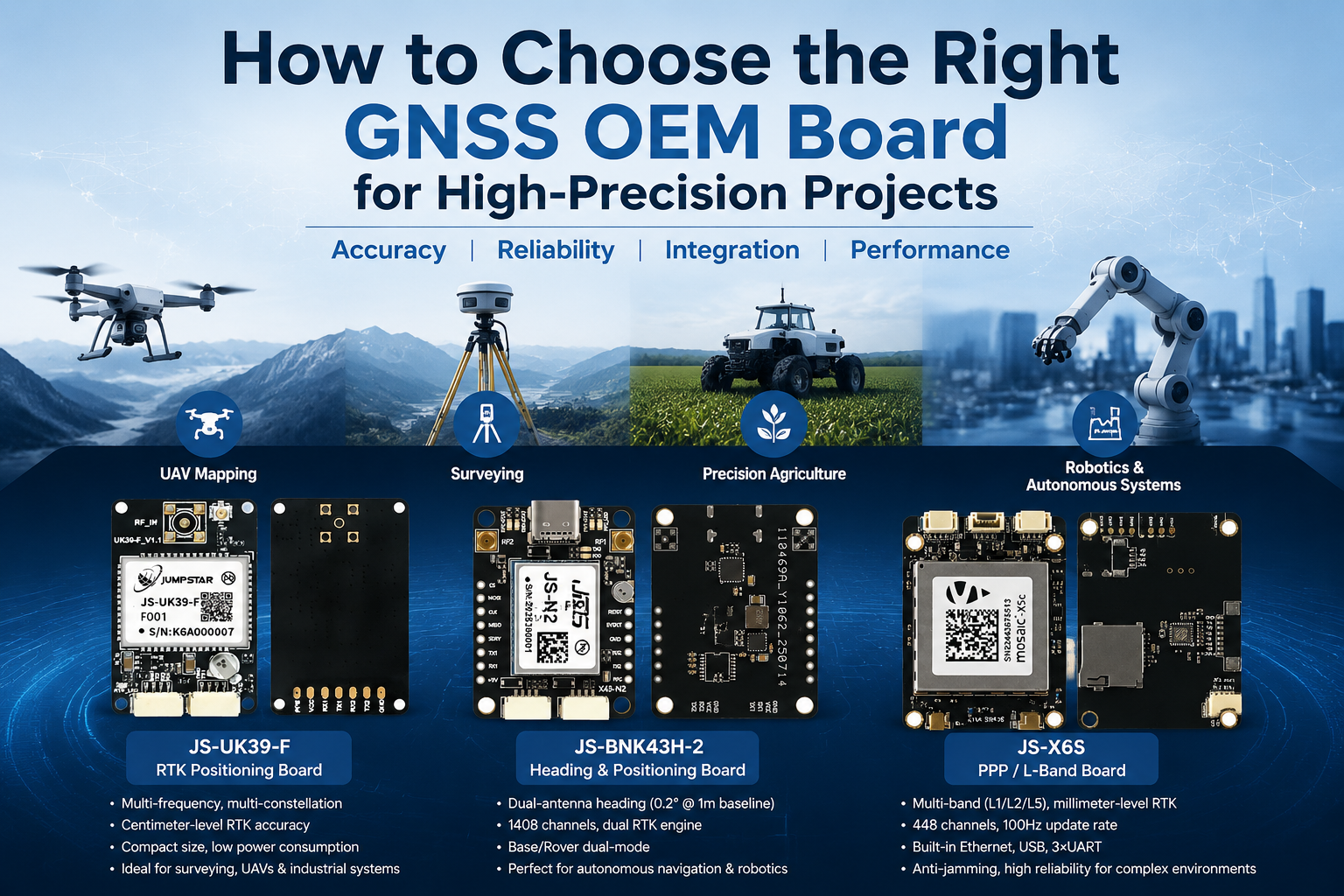
The JS-UK39-F is a multi-constellation, multi-frequency RTK OEM board designed for applications requiring reliable centimeter-level positioning. It achieves RTK accuracy of 1cm + 1ppm with a tracking sensitivity of minus 167dBm and a 25Hz update rate. The board supports L1/L2 frequency bands across all major constellations, operates on a 3.3V to 5.5V wide voltage supply, and functions in both base and rover modes. Its compact embedded design and low power consumption make it ideal for size-constrained platforms.
View Product DetailsSuitable applications: UAV mapping, surveying equipment, industrial positioning systems, automotive electronics, and robotics where centimeter-level accuracy is required but dual-antenna heading is not necessary.
2. GNSS OEM Boards with Heading Capability for Autonomous Systems
Autonomous systems often require both position and orientation information. While a single-antenna GNSS board can derive heading from movement, this approach fails when the vehicle is stationary or moving slowly. Dual-antenna heading-capable boards solve this by computing heading from the carrier-phase difference between two antennas, providing reliable orientation independent of motion.
.png?imageMogr2/format/webp)
JUMPSTAR JS-BNK43H-2
Dual-Antenna Heading GNSS OEM Board for Autonomous Systems
The JS-BNK43H-2 is a dual-antenna heading GNSS OEM board featuring 1408 tracking channels and a 2GHz dual-core CPU. It provides dual-antenna heading accuracy of 0.2 degrees, instant RTK initialization in under 5 seconds, and supports L1/L2/L5 frequencies across all major constellations. The board operates in base/rover dual mode, outputs at 20Hz, and is designed for compact integration into autonomous platforms where both positioning and orientation are mission-critical.
View Product DetailsSuitable applications: UAV navigation, robotics, autonomous vehicles, precision agriculture, intelligent lawnmowers, and any platform requiring reliable heading without relying on magnetic compass sensors.
3. Advanced Multi-Band GNSS OEM Boards for High-Dynamic Applications
The most demanding applications, such as autonomous driving and high-speed robotics, require advanced positioning performance with ultra-low latency, high update rates, and robust anti-interference capabilities. These applications benefit from multi-band boards with extensive channel counts and sophisticated signal processing.
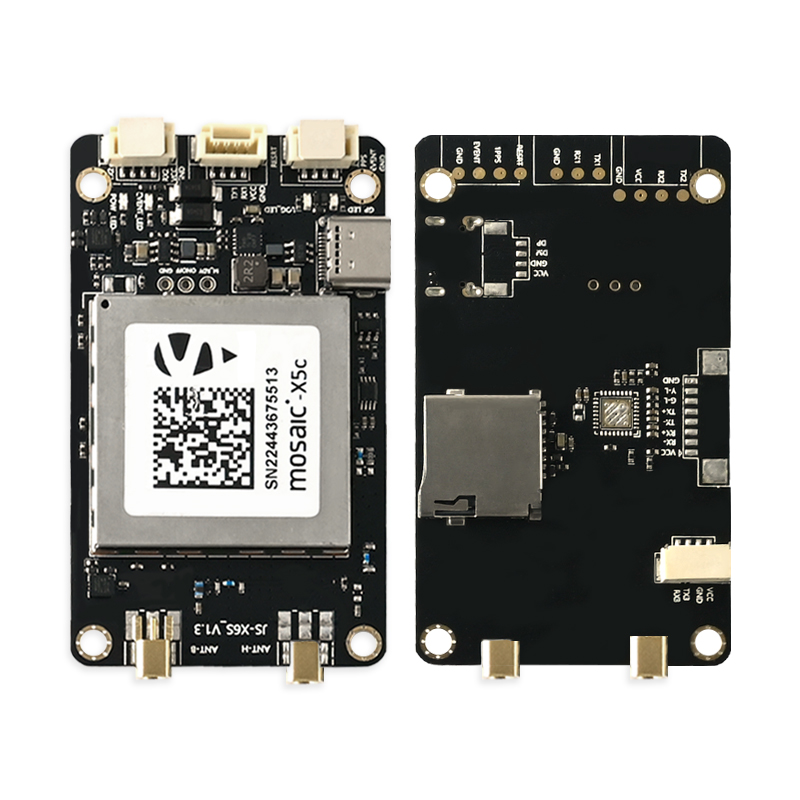
JUMPSTAR JS-X6S
Advanced Multi-Band GNSS OEM Board for High-Dynamic Applications
The JS-X6S is an advanced multi-band GNSS board featuring 448 hardware channels, RTK millimeter-level accuracy of 0.6cm + 0.5ppm, and a 100Hz update rate with sub-10-millisecond latency. It supports L1/L2/L5 multi-band multi-constellation reception, dual-antenna heading, and includes comprehensive anti-interference technologies including AIM+, LOCK+, APME+, IONO+, and RAIM+. An integrated Ethernet port enables high-throughput data transfer and network-based correction delivery, making it suitable for the most demanding positioning applications.
View Product DetailsSuitable applications: Autonomous driving, UAV systems, intelligent robots, precision control systems, and any application where millimeter-level accuracy, ultra-low latency, and robust anti-interference performance are essential.
How JUMPSTAR Helps OEM Customers Build Reliable Positioning Solutions
JUMPSTAR has established itself as an experienced GNSS OEM solution provider, offering a comprehensive portfolio of positioning boards designed for professional integration. The company's approach to OEM partnerships is built on several key advantages:
JUMPSTAR offers GNSS OEM boards spanning standard-precision, RTK centimeter-level, dual-antenna heading, and millimeter-level RTK tiers. This allows customers to select the exact board that matches their accuracy and performance requirements without overpaying for unnecessary capabilities.
Each board is designed for straightforward OEM integration, with standard communication interfaces including UART, USB, Ethernet, and PPS output. This flexibility reduces development time and simplifies host system architecture.
JUMPSTAR understands that different applications have fundamentally different requirements. UAV mapping demands compact size and low power. Autonomous vehicles need dual-antenna heading and anti-interference. Surveying requires millimeter accuracy. The product portfolio is structured to address these distinct needs.
OEM projects require more than a hardware component. JUMPSTAR provides integration support, firmware configuration assistance, and application-specific technical guidance to help customers successfully embed GNSS positioning into their products.
Conclusion
Choosing the right GNSS OEM board is a systems engineering decision that impacts positioning accuracy, application environment performance, integration complexity, communication architecture, and long-term reliability. The selection process requires a clear understanding of the project's accuracy requirements, operating environment, dynamic behavior, and host system interfaces.
By evaluating positioning accuracy tier, constellation and frequency support, processing capability, interface options, and environmental reliability, engineers can narrow the field to boards that genuinely fit their application. JUMPSTAR provides a comprehensive range of GNSS OEM board solutions, from compact RTK modules to advanced multi-band boards with millimeter-level accuracy, supporting next-generation intelligent systems across UAV, robotics, autonomous vehicle, and surveying industries.
Need help selecting the right GNSS OEM board for your project? Explore JUMPSTAR's full product range or contact our engineering team for personalized consultation.
Explore JUMPSTAR GNSS OEM Board Solutions Contact JUMPSTAR Technical Experts.png?imageMogr2/format/webp)
.png?imageMogr2/format/webp)